
Four Australian-designed catamarans turn up on the same shortlist again and again: the Fusion 40, the Seawind 1160, the Schionning kit designs and the Lightwave 38. All four are 38 to 40 feet, all four were drawn by people who meant to cross oceans in them, and the used examples we read this week sit between AUD 315,000 and 419,000. The differences are in how they were built, how much they weigh and what to check before you pay.
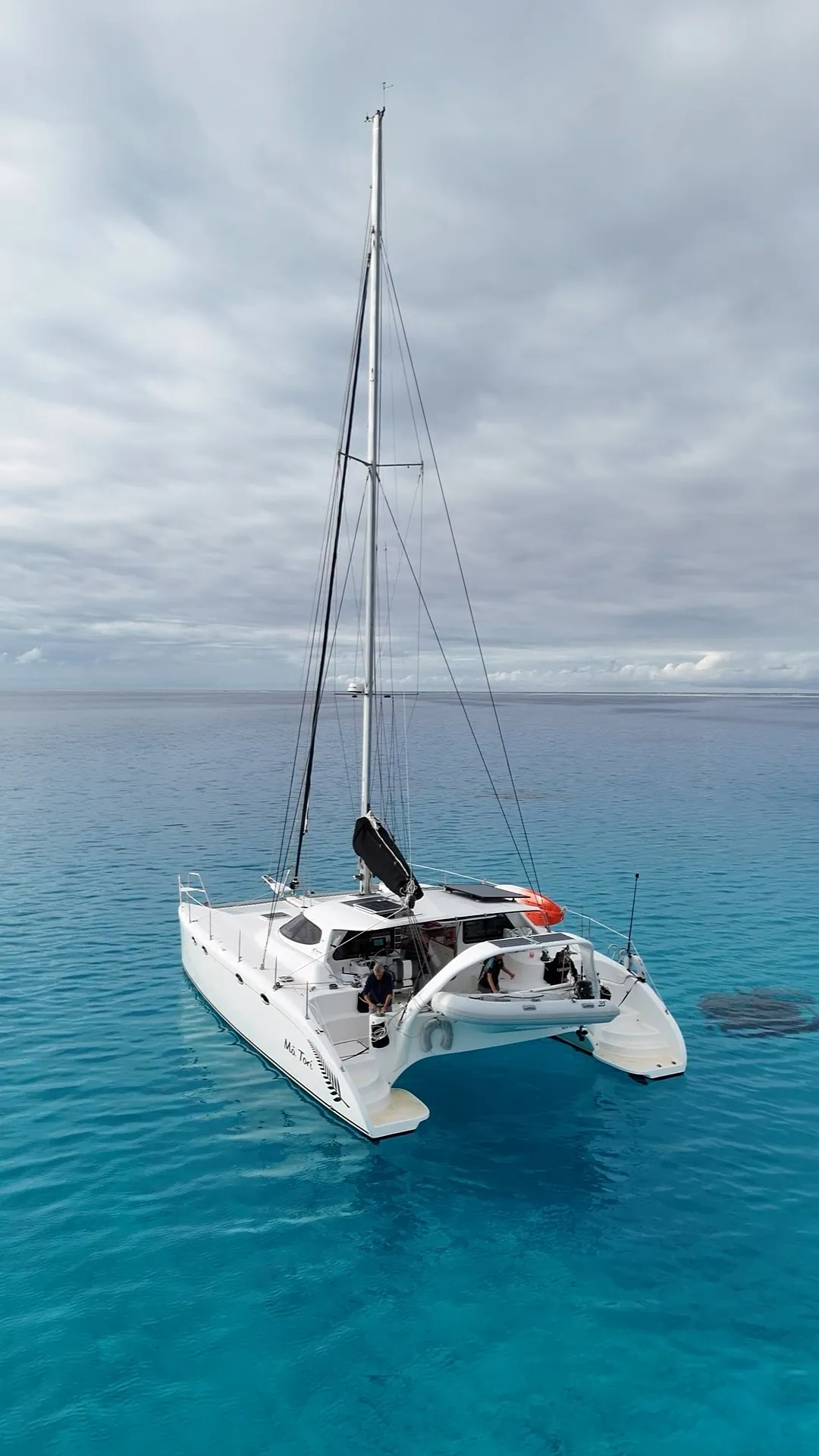
One thing up front. We sail a Fusion 40 and she is for sale, so read the verdicts with that in mind. The figures come from the builders' pages, one independent used-boat review and current Australian listings, and we say where a number is missing.
Who built what, and how
The Fusion 40 is a Gary Lidgard design sold as a modular kit, professionally moulded and finished by the factory, a yard or the owner. Around 60 were built, resin-infused foam sandwich topsides over solid glass below the waterline. Our Fusion 40 review has the full spec sheet.
The Seawind 1160 is the production boat of the group. Seawind started in Wollongong in 1982 and Richard Ward's 1160 arrived at the end of 2004. Practical Sailor's used boat review of the Seawind 1160 (Darrell Nicholson, updated June 2025) puts the run at about 120 boats between 2004 and 2012, after which production moved to Vietnam, where the 1160 Lite, the 1160XL and the 1170 are built now. Foam sandwich in vinylester, resin infused on the later boats.
The Schionning boats are kits and plans, not a model, from Jeff Schionning's family business, which has been drawing cats for more than 30 years. In an interview with Schionning's Robert Quinn, the company put its output at roughly six boats a year over the last decade, the flat-panel Arrow 1200 the most commonly built. Older names on the used market are Wilderness, Cosmos and Waterline. Every one was finished by a yard or an owner, and Schionning does not track which plans got built. The builder is the brand.
The Lightwave 38 is a production boat from a small yard. Lightwave, founded in 1996 by Roger Overell in Queensland, builds to order and has launched more than 80 cats. The 38 was launched in 2002 and re-released in 2006 and 2010, and it is no longer in the range; Lightwave's previous models page still carries the full specification, and the yard now builds a 46 foot power cat and a 55.
The numbers side by side
Builder figures where the builder publishes them. The Fusion 40 displacement is not on any sheet we can point to, so we leave it blank rather than guess.
| Spec | Fusion 40 (Mā Tori) | Seawind 1160 / 1160XL | Schionning Arrow 1200 (typical) | Lightwave 38 |
|---|---|---|---|---|
| LOA | 12.2 m | 11.6 m / 11.83 m | About 12 m by name; varies by build | 11.3 m |
| Beam | 7.0 m | 6.5 m / 6.6 m | Not published on a page we can open | 6.67 m |
| Draft | 1.1 m | 1.1 m / 1.29 m | Varies by build | 1.1 m |
| Displacement | Not published | 7,000 kg / 7,800 kg | Varies by build | 5,000 kg light, 6,500 kg loaded |
| Engines | 2 × Yanmar 3YM30 saildrives | 2 × 30 hp Yanmar saildrives or outboards; XL standard is twin 25 hp outboards | Owner's choice | 2 × 29 hp Yanmar or Volvo saildrives, folding props |
| Working sail area | See the review | 75 m² / 87 m² | Varies | Main 47 m², jib 20 m² |
| Cabins | 3 queen, owner's hull to port | 3 or 4 | Varies | 3 standard, 2 to 4 offered |
| Built | About 60 | About 120 (2004 to 2012), then Vietnam | Hundreds across all designs | Part of 80 plus since 1996 |
Two things jump out. The Lightwave 38 is the lightest boat here by a margin, 5,000 kg light ship against 7,000 kg for an original Seawind 1160. And the newer Seawinds get heavier with each version: the 1160XL is 7,800 kg and the Seawind 1170 is 9,200 kg on an 11.9 m hull, with twin 29 hp Yanmar saildrives and stub keels. More boat, more weight to push.
Weight, and what it costs you at sea
We have written before about why a kit or owner-completed cat is usually lighter and stiffer than a charter-spec production boat. A light cat carries her cruising load without sinking below her lines, which keeps the bridgedeck clear and the boat moving in 8 knots. The flip side is that on a Schionning or a Fusion there is no brochure weight to trust, only the boat in front of you. Ask for the launch weight, and if nobody knows, assume the heavier number.
Sailing them
Practical Sailor's reviewer found the Seawind 1160 tacks well for a multihull, is quiet under power and is easy shorthanded with the self-tacking jib and the traveller on the targa bar. He also called its performance modest, found the steering heavier than he liked (Seawind later changed it to pull-pull cables), and noted tight engine access. The tri-fold door that opens the saloon into the cockpit is the feature every owner mentions. The Seawind 1160XL keeps the door and adds a carbon front beam, raised freeboard and a bigger rig; the launch is in our Seawind 1160XL at Newport post.
Lightwave quotes the 38 at 16 knots plus under sail and 7.5 knots under power at 2,500 rpm. We have not sailed one, so take the top number as a builder's number. What the sheet does tell you is that a 5,000 kg boat with a 47 m² main and a self-tacking jib will be quick in light air and easy on a couple.
A Schionning depends on which design and who built it, and the fast ones are very fast. The flat-panel Arrows save about three months of build time over the strip-planked G-Force designs; it also means the panels are straight, so look hard at the fairing.
The Fusion 40 is the widest of the four, 7.0 m of beam against 6.5 to 6.67 m. That beam is why she has three queen cabins and why the platform is so stable at anchor. Our own miles are first hand, four New Zealand to Fiji round trips, and the account is in the Fiji to Opua passage post.
What they cost on the used market right now
Asking prices, not sale prices, read on 13 November 2026.
- Seawind 1160: a 2005 Seawind 1160 Deluxe with twin Yanmar 3YM30 saildrives, 700 W of solar and a Spectra watermaker is AUD 419,000 in Jervis Bay. Practical Sailor's 2025 market scan found a 2013 boat at USD 249,000 and a 2023 at USD 455,224.
- Schionning: on boatsonline.com.au the same day, a 2006 Wilderness 1100 that has been re-powered with new drives and sails was AUD 315,000, a 2005 Cosmos 1160 was AUD 330,000 in Brisbane, and a 2009 Wilderness 1250X was AUD 379,000 at Raby Bay. Three designs, three builders, which is the Schionning market in one line.
- Lightwave 38: a 2006 Lightwave 38 with twin 29 hp Yanmars on about 3,500 hours, 750 W of solar and a Spectra watermaker is AUD 330,000 in Sydney.
- Fusion 40: Mā Tori is USD 299,000 with lithium, solar, watermaker, new sails and current Cat 1. There is rarely more than one Fusion on the market at a time, so there is no price curve to show you.
The pattern is the one in the best cruising catamarans under 500k: on these listings the production badge carries a premium of roughly AUD 90,000 over a Lightwave or Schionning of the same age, and the kit boats sell on inventory and survey, not name.
What we would check on each one
The general list is in our catamaran survey checklist. These are the extras.
Seawind 1160. Which build era, hand laid or infused. Whether the steering has been converted to pull-pull cables. The tri-fold door hinges, lanyards and latches. Saildrives or outboards, and if saildrives, the diaphragm date. The mini keels are thick solid glass, so grounding damage is obvious and fixable. Ex-charter boats from the Whitsundays carry the hours; a 2008 boat listed out of Airlie Beach had both engines past 6,700 hours.
Schionning. Who built it, and get the name. Plans, build photos, launch weight. Fairing and paint, because that is where a home build shows. Daggerboard cases and bearings if she has boards. Whether the design is still supported; the Waterline 1480 was retired and older designs are not fully documented digitally.
Lightwave 38. Engine hours against the price. Bridgedeck clearance is 0.75 m, fine for a 38 footer, but check the underwing for slamming damage. Which of the three releases it is, and which layout, because galley up or down and two to four cabins were all offered.
Fusion 40. Saildrive boots, the hull-deck joint, the bulkheads, the age of the standing rigging and the lithium install. On Mā Tori those were done in the 2022 refit and are written up for the buyer. If you are importing any of these into New Zealand, the NZ buying guide and the Cat 1 inspection checklist cover the GST, biofouling and inspection side.
So which one
If you want a boat a surveyor and an insurer both recognise, with a factory still building the type, buy the Seawind 1160 and pay the premium. If you want the lightest, quickest boat for a couple and can live with a 38 foot interior, a well-kept Lightwave 38 is hard to beat at the price. If you want a fast cat and have the patience to find the Schionning that was built properly, that is where the bargains are, and the risk. If you want the biggest platform of the four, three queen cabins, 7 m of beam and the systems and certification already done, that is our Fusion 40, and the verdict is only worth as much as the survey you get done on her. Ask us anything about her.
Questions people ask about these four catamarans
Is a Seawind 1160 a bluewater boat?
Yes. Around 120 of the original run were built for Australian coastal and offshore cruising, and the current versions carry ISO Category A. Practical Sailor's review calls its performance modest rather than quick, which is fair for a 7 tonne cruising cat.
How much does a used Seawind 1160 cost?
On 13 November 2026 a 2005 Seawind 1160 Deluxe was listed at AUD 419,000 in New South Wales. Practical Sailor's 2025 market scan found a 2013 boat at USD 249,000 and a 2023 boat at USD 455,224. Ex-charter boats sit lower.
Are Schionning catamarans any good?
The designs are, which is why an estimated several hundred have been built. The boat in front of you is only as sound as the yard or owner who built it, because Schionning sells plans and kits, not finished boats. Judge the builder and the survey, not the name on the plans.
Is the Lightwave 38 still in production?
No. Lightwave lists it under previous models, launched 2002 and re-released in 2006 and 2010, and the yard now builds power and motor-sailing cats. Used examples come up in Queensland and New South Wales; the 2006 boat we read in Sydney was asking AUD 330,000.
Keep reading: Fusion 40 vs Lagoon 42, Fusion 40 vs Leopard 40, Fusion 40 vs Fountaine Pajot Isla 40, and the printable checklists in the Catamaran Buyer's Pack.