
A pre-purchase survey on a cruising catamaran comes down to six things: the bulkheads and the structure between the hulls, the chainplates and standing rigging, the saildrives, wet core in the decks, the electrics, and the paperwork that shows when each was last done. The rig above deck level, the engines and the gas are often outside the scope, so you book a rigger and a mechanic as well. We are the crew of a Fusion 40 that is for sale, so this is also the list we expect a buyer to run on us.
What a survey covers and what it leaves out
Ben Sutcliffe-Davies, a surveyor with the Yacht Designers and Surveyors Association, says it plainly in Yachting World's guide to getting a yacht survey: "We can only survey what we can see. There's no crystal ball." The article lists what a normal survey takes in: hull, deck and topsides for structure and moisture, skin fittings and hoses, rudders, the engine installation, the onboard systems and the service dates on the safety gear.
It also says what sits outside. The rig is generally checked at deck level only, and a gas safety check is generally not included. Read the surveyor's terms before you book and agree the scope in writing: haul-out, rig, engines, sails, moisture readings.
The International Institute of Marine Surveying's tips on buying a boat say to make the offer "subject to a Marine Survey and, if necessary, a sea trial". Its page on choosing a marine surveyor says to pick someone with experience of the type of boat, ask them to confirm their professional indemnity cover is current, and get more than one quote because prices vary a lot. On a catamaran, ask how many cored composite multihulls they have surveyed.
Ask for the paperwork before you pay a surveyor
Most of this can be checked from invoices before anyone travels. Ask the seller for:
- The date the standing rigging was last replaced, with the rigger's invoice.
- The date the saildrive diaphragms were last replaced, and the last out of water service on the drives.
- The refit history with invoices: sails, electrics, batteries, antifoul.
- The make and model of the batteries and who installed them.
- Any earlier survey reports, including an insurer's condition survey.
- In New Zealand, the date on the last Cat 1 or International Voyage Certificate.
Practical Sailor's rule for rigging applies to all of it: unless the replacement is properly documented, assume the part is original. What a certificate proves is in our NZ Cat 1 inspection guide, and the offer and export side is in the guide to buying a catamaran in New Zealand.
Bulkheads and the structure between the hulls
A catamaran's bulkheads take the rig loads and hold two hulls square to each other. The best documented case is the Lagoon 450. In October 2021 Yachting Monthly's Lagoon 450 bulkhead report said the builder had received reports of deformed or broken forward bulkheads and was paying for inspections. Lagoon said its designers, VPLP, found no safety issue in sailing with one, and that 80 percent of the boats inspected had no deformation or were only lightly affected. Practical Sailor's Big Cat Concerns article in February 2023 describes bulkheads that had pulled away from the hull, and tells buyers to have the surveyor crawl in and inspect every corner.
That is one model from one builder. The checklist it leaves you with works on any cat:
- Cracks, warping or delamination in the main and forward bulkheads.
- Bulkheads and stringers that are glued in but not taped and glassed to the hull.
- Joinery that has shifted, or rigging gone slack for no reason.
- Any repair or reinforcement, with the paperwork for who did it.
- The joins between the hulls and the bridgedeck, inside and out.
On an owner-completed boat the standard of this work depends on who did it, which is the subject of our guide to owner-built and production catamarans and why the Fusion 40 review says to judge the individual boat with a surveyor. What surveys find on ex-charter boats is in our Fusion 40 and Lagoon 42 comparison.
Chainplates and standing rigging
The survey generally stops at deck level, so book a rigger. Practical Sailor's rig survey guide puts wire standing rigging at eight to 10 years, sooner with offshore passages. Yachting Monthly's piece on when a rig needs a service says insurers often ask for a full rigging survey at about 10 years. What to look for from the deck first:
- Broken strands, and corrosion where the wire enters a swage.
- Cracked or bent swage fittings. Start with the lower ones, because salt water runs down the wire into them.
- Rust stains running from a terminal or a chainplate.
- Chainplates that move, leak, or have stretched pin holes.
- Discolouration or delamination where a chainplate bolts to a bulkhead.
Chainplates also corrode where you cannot see them. Practical Sailor describes crevice corrosion as stainless steel sitting in stagnant water inside a wet deck while the metal you can see looks fine. A hairline crack around a chainplate fitting took a boat out of this year's Golden Globe Race, and most cruising cats have no backstay, so the shrouds do even more of the work. Both are in our Golden Globe Race lessons post.
Saildrives, two of them
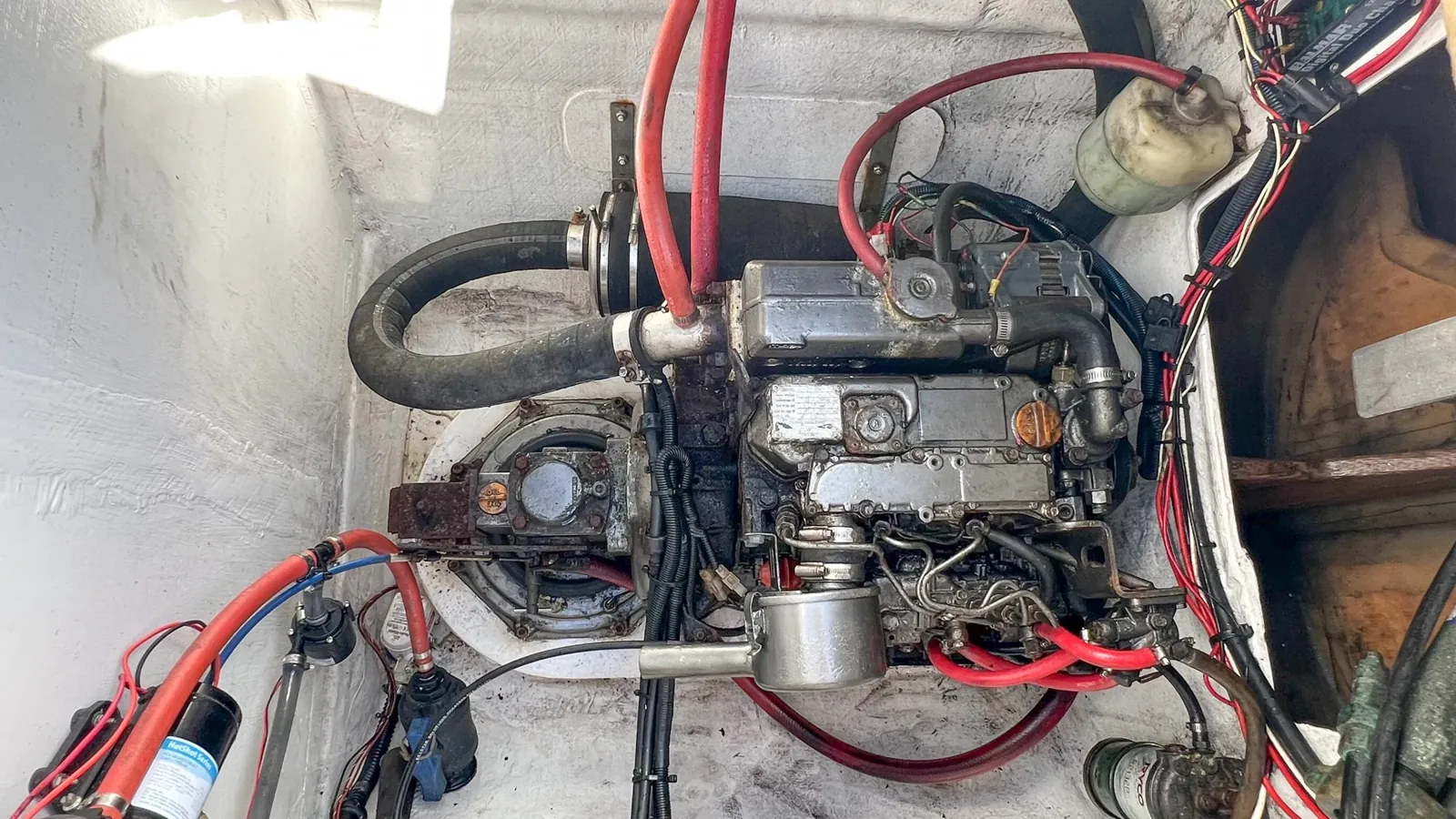
Each saildrive sits in a hole in the hull sealed by a rubber diaphragm. Yanmar's SD series operation manual (April 2026 edition, covering the SD25, SD60, SD110 and SD150) says the diaphragm and its clamp ring are replaced every seven years. On the SD25 and SD60 the diaphragm is double layered with a sensor between the layers that sounds an alarm if water gets in. The SD110 and SD150 have a single layer and no alarm.
Volvo Penta's figure is seven years too, according to Practical Boat Owner's engine expert, who says seals often last longer but prints a reader's account of one found split nearly through after a summer ashore in 42 degree heat. A thorough check means taking the leg off. So ask for the invoice with the date, and with no invoice budget for both drives.
Wet core and moisture readings
In Soundings' guide to telling if a core is wet, a fibreglass repairer and a surveyor say water gets in through loose or badly bedded deck hardware, stanchion bases, hinges and locker latches. Both check with a hammer. Sound laminate over dry core gives a crisp note and the hammer bounces back. A wet core sounds deep and dull.
The surveyor will use a moisture meter as well. Photograph every reading with where it was taken. None of the sources here gives a pass mark, so we will not either. Walk the decks first and check every fitting added after the build. Mā Tori is solid fibreglass below the waterline with foam sandwich above it, so on our boat this is about decks and topsides.
Electrics and lithium
This is where a refitted or owner-completed boat shows its standard: labelled, tinned wiring, proper fusing and seacocks you can reach.
Lithium needs its own questions. The American Boat and Yacht Council ratified its first lithium standard, E-13, in 2022. Ben Stein's Panbo write-up of ABYC E-13 says it requires a battery management system on every battery, and that the batteries are installed, run and maintained the way the maker's manual says. The standard is American, but the questions travel:
- The make and model of the batteries, and whether the manual is aboard.
- Whether every battery has a BMS, and what the alternators and chargers do when it disconnects.
- Who installed the system, and the invoice.
- Whether your insurer will accept it. Ask before you buy.
Our listing has a 540 Ah lithium house bank, 700 W of solar and a 2000 W inverter, so expect to ask us all four. Gas and temperature alarms for lithium banks are in our post on safety kit that is getting better, and the SafeLi lithium gas alarm review goes through what one does and does not do. We have not tested one.
The sea trial and the report
The sea trial is where the rig, engines and autopilot work under load. Run both engines up to temperature. Sail hard on the wind on each tack and have someone watch the leeward shrouds.
The report comes to you. Sutcliffe-Davies warns against treating it as a bargaining tool, and a survey can end a deal as well as reprice one. Before the surveyor leaves, ask which items are dangerous, which are maintenance, and what they could not get at. Many insurers want a condition survey before they will cover a boat, so ask yours what they need first.
If you come to look at our Fusion 40, bring this list. Pre-purchase surveys and sea trials are welcome by arrangement.
What we don't know
- We are sailors selling a boat, not surveyors. Everything above comes from the sources linked, and a surveyor on the boat outranks all of it.
- What a survey costs where you are. We have not collected quotes.
- Whether Yanmar's seven years applies to an older drive. Check the manual for the drive on the boat.
Survey scope, service intervals, standards and insurer requirements change. Check the maker's current manual, and ask the surveyor and your insurer, before you rely on anything here.
Questions people ask about catamaran surveys
What does a catamaran pre-purchase survey cover?
Hull, deck and topsides for structure and moisture, skin fittings, rudders, the engine installation, the onboard systems and the dates on the safety gear. On a catamaran add the bulkheads and the joins between the hulls and the bridgedeck.
Does a survey include the rig and the engines?
Usually only in part. Yachting World's guide says the rig is generally checked at deck level only and a gas safety check is generally not included.
How often should saildrive diaphragms be replaced?
Yanmar's SD series operation manual (April 2026 edition) says every seven years. Practical Boat Owner reports the same figure from the Volvo Penta manual. Ask the seller for the dated invoice.
How long does standing rigging last?
Practical Sailor puts wire standing rigging at eight to 10 years, sooner with offshore passages. If the seller cannot show when it was replaced, assume it is original.
Keep reading: the survey is step four of buying a used catamaran: start here; the printable checklists are in the Catamaran Buyer's Pack, the shortlist is in best cruising catamarans under $500k, and our bluewater catamaran for sale is the boat this was written from.