
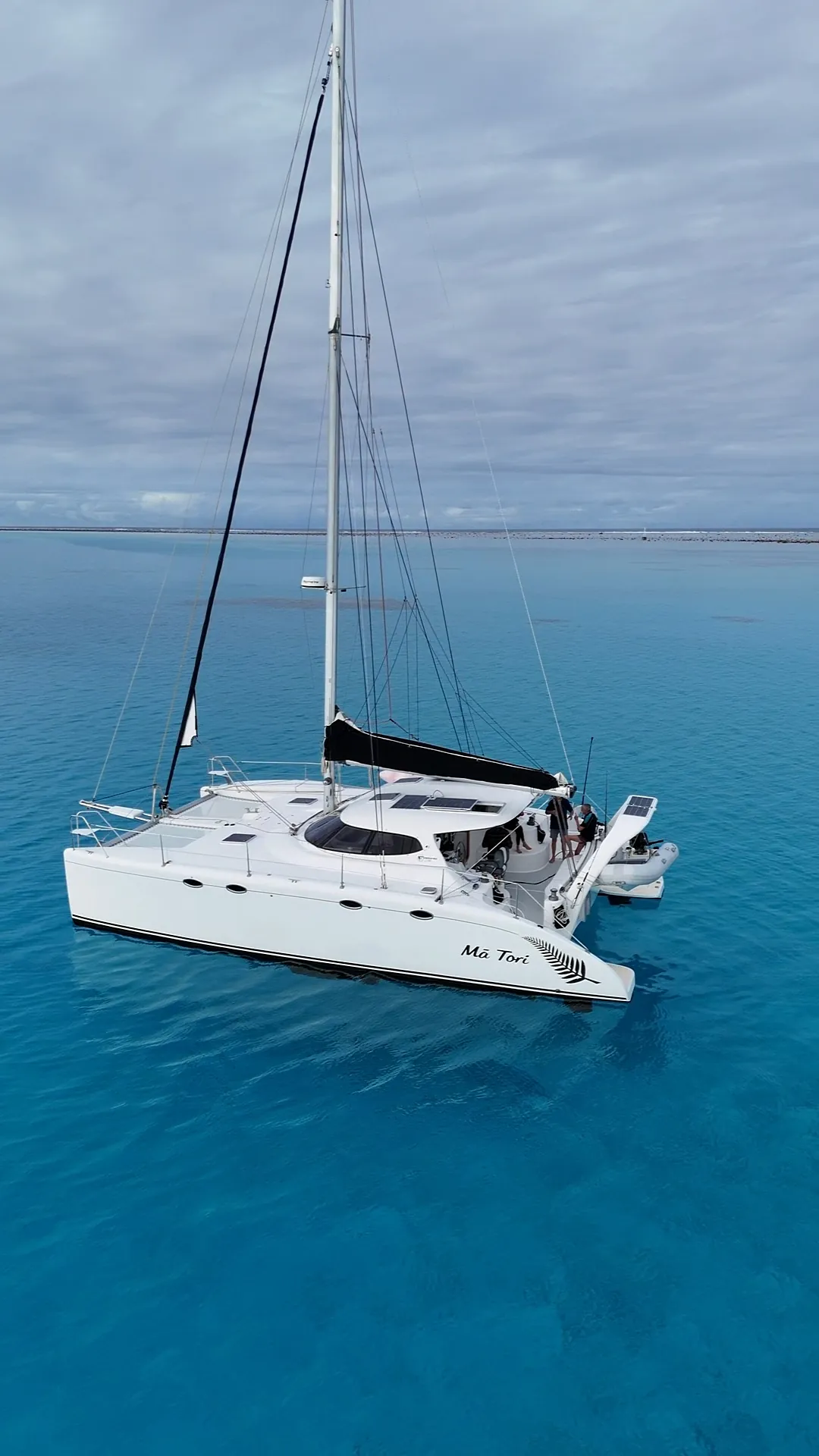
If you're shopping for a 40 something foot cruising cat, sooner or later you'll be staring at a Lagoon 42 listing. Everyone does. It's one of the best selling cruising cats ever built and there are good reasons for that. We own and sail a Fusion 40, Mā Tori, and she's for sale right now, so read all of this with that in mind. We've also spent a fair bit of time aboard Lagoons, hauled out next to Lagoons and anchored beside Lagoons, enough to have a pretty clear view of where each boat wins. This isn't a hit piece. The Lagoon 42 is genuinely good at what it was drawn to do. The point is that the two boats were drawn to do quite different things, and working out which of those you actually want is worth more than any spec sheet. Most Lagoon 42 reviews get written at boat shows. This one comes from the anchorage alongside. And if what you're really after is a Lagoon 42 alternative, the lighter end of this comparison is worth a proper look.
Two very different design philosophies
The Lagoon 42 is a VPLP design built in Bordeaux by one of the biggest boatbuilders on the planet. The brief is volume, comfort and ease. Gullwing bridgedeck, self tacking jib, huge interior, a layout that works just as well for a family living aboard as it does for a charter fleet. Thousands of people have gone round the world in Lagoons. The design has been refined over an enormous production run and the ownership side of it, parts, brokers, insurers, surveyors who know the boat, is about as easy as it gets in yachting.
The Fusion 40 comes at it from the other end. Gary Lidgard drew it as an Australian kit cat, around 60 got built, hulls resin infused in proper moulds and the boats finished either by yards or by owners who knew what they were doing. The brief was a light, quick, easily driven cruising cat that a couple could handle offshore. Lagoon went for volume, Lidgard went for weight, and that one decision runs through everything else in this comparison.
Build and weight: what a few tonnes means at sea
The Fusion 40's topsides are resin infused foam sandwich in vinylester, over solid glass below the waterline. The vinylester bit matters. It's a lot more resistant to osmosis than the standard polyester in most production boats of that era, and infusion gets you glass to resin ratios that hand layup can't match. What you end up with is a stiff, light structure. For a 12.2 metre cat with 7 metres of beam the Fusion 40 is properly light.
The Lagoon 42 is a well engineered production layup that typically comes in around 12 tonnes light ship, and a good bit more once the cruising gear, the tankage and everything the owners own has come aboard. That's not a dig. The weight buys you huge interior volume, decent sound insulation and that solid planted feel. But displacement is the tax every catamaran pays on performance. A heavier cat needs more sail to move her, loads the rig and the hardware harder, motors more in light air and burns more diesel doing it.
At sea the difference shows up in ways a spec sheet never will. A light cat gets going on small pressure. She rides over the waves instead of shouldering through them. And when the window is marginal, which on the NZ to Fiji run it pretty much always is, a boat that sails properly in 8 knots gives you options that a boat needing 14 just hasn't got.
Head-to-head specifications
| Spec | Fusion 40 (Mā Tori) | Lagoon 42 |
|---|---|---|
| LOA | 12.2 m | Around 12.8 m |
| Beam | 7.0 m | Around 7.7 m |
| Draft | 1.1 m | Around 1.25 m |
| Displacement (approx.) | Light for her size, a genuine performance cruiser weight | Typically around 12 t light ship, more loaded |
| Cabins | 3 queen cabins (owner's hull to port) | 3 or 4 cabins depending on version |
| Engines | Twin Yanmar 3YM30 29 HP saildrives | Typically twin 45–57 HP saildrives |
| Typical used price | USD $299,000 fully refitted, Cat 1 | Typically around US$400k–650k depending on year and condition |
| Offshore setup notes | Cat 1 certified; watermaker, 700W solar, 540Ah lithium, Starlink + Iridium already fitted | Strong offshore pedigree; ex-charter examples usually need systems upgrades for bluewater independence |
Sailing performance
This is where the two boats split furthest apart. The Lagoon 42 sails better than her critics reckon. The current generation especially, with the mast moved aft and a bigger self tacking jib, is an honest passagemaker that will knock off steady 150 to 180 mile days in the trades. The self tacker makes short handed sailing about as easy as it gets, and the gullwing bridgedeck does a reasonable job of softening the wave slap for the clearance it has.
But physics is physics. A light, easily driven hull with fine entries just does more with the same breeze. The Fusion 40 keeps sailing in single digit wind where heavier cats are firing up the diesels, she points a little higher, and she rewards trimming properly in a way that keeps sailing interesting rather than something you do to get there. Decent bridgedeck clearance for her weight means less slamming in a seaway than you'd expect from a 40 footer. Across four NZ to Fiji seasons we've had consistent, comfortable daily runs with two of us aboard and never once wished for a heavier boat.
The other side of it is real though. All that extra Lagoon mass gives a steadier, less lively motion at anchor and in chop, and some crews, anyone who gets seasick or has little kids aboard for a start, genuinely prefer that. Lively is a feature for some sailors and a pain for others. Work out which one you are before you buy.
Draft, and where you can take her
Mā Tori draws 1.1 metres. The Lagoon 42 typically draws around 1.25. On paper that's nothing. In the Pacific it's the difference between tucking inside a reef pass at half tide and waiting outside, and between drying out on a Northland beach for a scrub and paying for a haul out. Neither boat is deep by monohull standards, that's one of the great things about cats, but the shallower boat gets the better spot in the anchorage every single time.
Layout and liveaboard space: the Lagoon genuinely wins here
No point dancing around it. If interior volume is your priority, buy the Lagoon. The 42's saloon is enormous, the cabins are bigger, there's headroom everywhere, the galley works for a crowd and the aft cockpit is a proper outdoor room. The four cabin version sleeps eight plus in real comfort. For a family living aboard full time, or owners who have six people round for sundowners every week, that volume isn't a luxury, it's the whole reason to buy the boat, and no 40 foot performance cruiser gets near it.
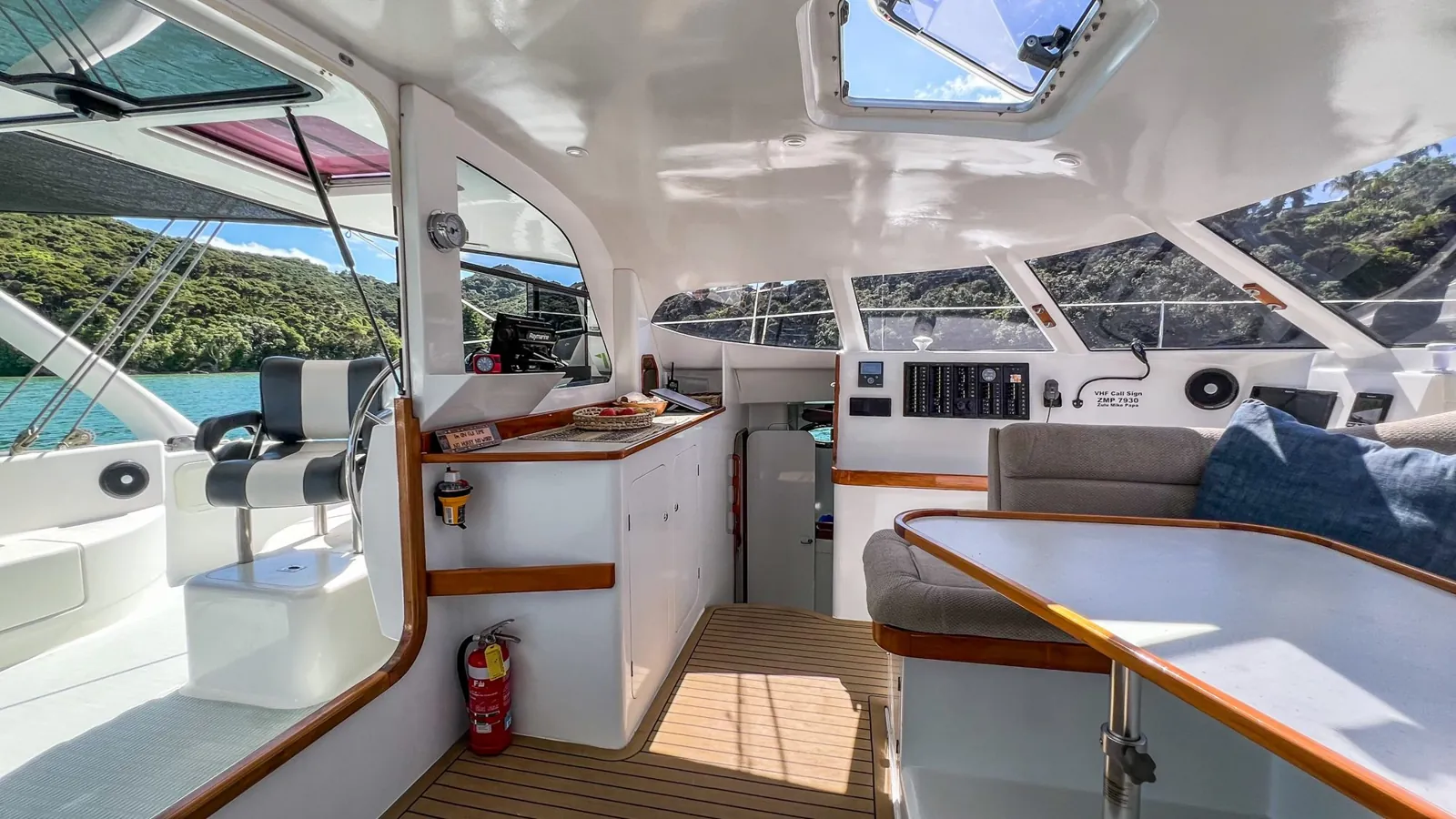
What the Fusion 40 gives you instead is better space rather than more of it. The panoramic saloon puts you at eye level with the anchorage through big windows, the galley to saloon to cockpit flow works really well for a couple or a small crew, and all three cabins have genuine queen berths, which is rare at this size. Mā Tori's owner's hull to port has an electric head and a separate shower, so she feels like an owner's boat rather than a charter compromise. But we're not going to pretend a Fusion 40's interior is in the same league as a Lagoon 42's. It isn't, and anyone who walks through both will see it in about thirty seconds.
Systems and energy independence
A used boat is really a used set of systems, and this is where individual boats vary a lot more than the models do. Plenty of used Lagoon 42s, the ex charter ones especially, turn up with modest solar, lead acid batteries sized for marina life and no watermaker, because a charter boat plugs in every week. Budget honestly for it. A lithium conversion, a solar arch, a watermaker and comms can swallow US$40 to 60k and a season of installation time.
Mā Tori's 2022 refit was aimed squarely at being independent of the dock. 700W of solar into 540Ah of lithium with a 2000W inverter, an OceanF10 watermaker fitted in 2025, Raymarine electronics with autopilot, and Starlink plus Iridium for offshore comms. New sails in 2022, antifoul done June 2026. The twin Yanmar 3YM30s are small at 29 HP each, but a light hull needs a lot less pushing, and smaller engines mean cheaper servicing, cheaper parts and less diesel. On a heavy boat those engines would be undersized. On this one they're matched to the load.
Price for capability
A used Lagoon 42 typically sits somewhere around US$400k to 650k depending on year, spec and history. A refitted Fusion 40 at USD $299k is a different budget altogether, and the gap gets wider once you cost in the offshore upgrades a lot of used Lagoons still need. On ex charter Lagoons in particular, surveyors routinely flag high engine hours, tired running rigging, charter grade upholstery and soft spots in the deck areas that get walked on most. None of it rules a boat out. Charter boats are usually well looked after mechanically because downtime costs money. But it belongs in your total cost of ownership, not as a surprise after the survey.
The counterweight is real too. The Lagoon's resale market is deep. There are always buyers for a Lagoon 42, brokers everywhere know exactly how to sell one, and finance and insurance are straightforward. A Fusion 40 is a rarer boat with a smaller, loyal, buyer pool and you should expect a longer sale at the other end. If getting your money out quickly matters to you, that's a genuine point in the Lagoon column.
So who should buy which?
Buy the Lagoon 42 if you want maximum living space for a family or regular guests, you like the idea of a huge owner community with easy parts and broker support everywhere, you might want charter income to offset the costs (the Lagoon is built and certified for exactly that), resale matters to you, or you just prefer the solid planted feel of a heavier boat. All legitimate, all sensible, and for a lot of buyers one of them decides it.
Buy a Fusion 40 if you're a sailing couple or a small crew who actually wants to sail, light air included, you value low weight, shallow draft and modest running costs over sheer volume, you'd rather buy a boat that's already set up for offshore independence than fund a systems refit, and roughly USD $299k all in appeals more than US$450k plus the upgrades. If you're also weighing up the Lagoon 46, 51 or 55, lovely boats all of them, just know you're moving into a different budget class entirely, typically US$700k to well over a million once they're specced up, with running costs to match.
Short version. The Lagoon 42 is the better apartment and the Fusion 40 is the better sailboat. Which one is "the better catamaran" comes down to which of those two things you're actually buying.
Keep reading: for the full story on our boat start with our Fusion 40 owner's review, see how she stacks up against the wider field in the best cruising catamarans under $500k, or get into the trade offs in owner-built vs production catamarans. And if the Fusion side of this sounds like your kind of boat, Mā Tori is for sale now. Lagoons are French built, which now carries a cost of its own at the US border, see US boat import tariffs.
Still shortlisting? We've run the same head to head against the other three boats buyers put on this list: Fusion 40 vs Leopard 40 (the ex-charter question), Fusion 40 vs Fountaine Pajot Isla 40 and Fusion 40 vs Bali Catsmart.