
Mā Tori left Port Denarau in Fiji on 8 October 2026 and came alongside the quarantine dock at Opua at 0630 on 15 October: 7 days and about 1,050 nautical miles with 4 aboard. One rough first night with over 30 knots and the third reef in, 4 days of 10 to 16 knots forward of the beam, then a calm that had the engine on for much of the last 300 miles. Customs, the detector dog and the biosecurity officer had us fully cleared by 1130. It was her fourth season between New Zealand and Fiji, and the run south went about as well as that passage goes.
The boat, the crew and where the numbers come from
Mā Tori is a 2007 Fusion 40, refitted in 2022, with current NZ Cat 1 certification. For this passage she had 4 aboard: Capt. D as skipper, Cam on the galley and the helm, Ken, and me as first mate. Every figure below is from Capt. D's daily log, which went out over Starlink to the Mā Tori PredictWind tracker as we went. Where the log doesn't give a number, neither do we.
Day by day
| Day | Noon position | Run and distance to go | Conditions |
|---|---|---|---|
| Thu 8 Oct | Port Denarau | Cleared out, then away | First night over 30 knots and building, third reef in, a sea coming aboard |
| Fri 9 Oct | 19°33.9'S 176°19.5'E | 8.5 kn average, 944.5 nm to go | 16 knots, 1 m sea, 2 reefs and full headsail, 9 knots |
| Sat 10 Oct | 22°03.9'S 175°04.7'E | 155.6 nm in 24 hours, 788.9 nm to go | 16 knots, 1 m sea, full main and headsail |
| Sun 11 Oct | 24°44.2'S 173°40.0'E | 627 nm to go | ESE 12 to 14 knots at about 60 degrees, 7 knots |
| Mon 12 Oct | 27°42.6'S 172°47.6'E | 160 nm in 24 hours, 453 nm to go | 10 knots, screecher up, up to 9 knots |
| Tue 13 Oct | About 290 nm out | 757 nm run, 293 nm to go | Wind down to 4.3 knots, engine on |
| Wed 14 Oct | Past Cape Reinga at dusk | Into the last night | Light and shifty, engine then sail |
| Thu 15 Oct | Opua quarantine dock | Alongside 0630 | Cleared 1130 |
The course sat between 176 and 191 degrees for most of it, which kept us well west of Minerva Reef this time. We didn't stop.
What the weather did
The first night was the only hard part. We cleared out late after Customs at Denarau ran on island time, had a swim to give the hulls a scrub, and turned south into a breeze that went over 30 knots and kept building. Third reef, a short steep sea and not much sleep for anyone. By the next morning it had settled to 16 knots and a metre of sea, and we shook out to 2 reefs and full headsail and did 9 knots.
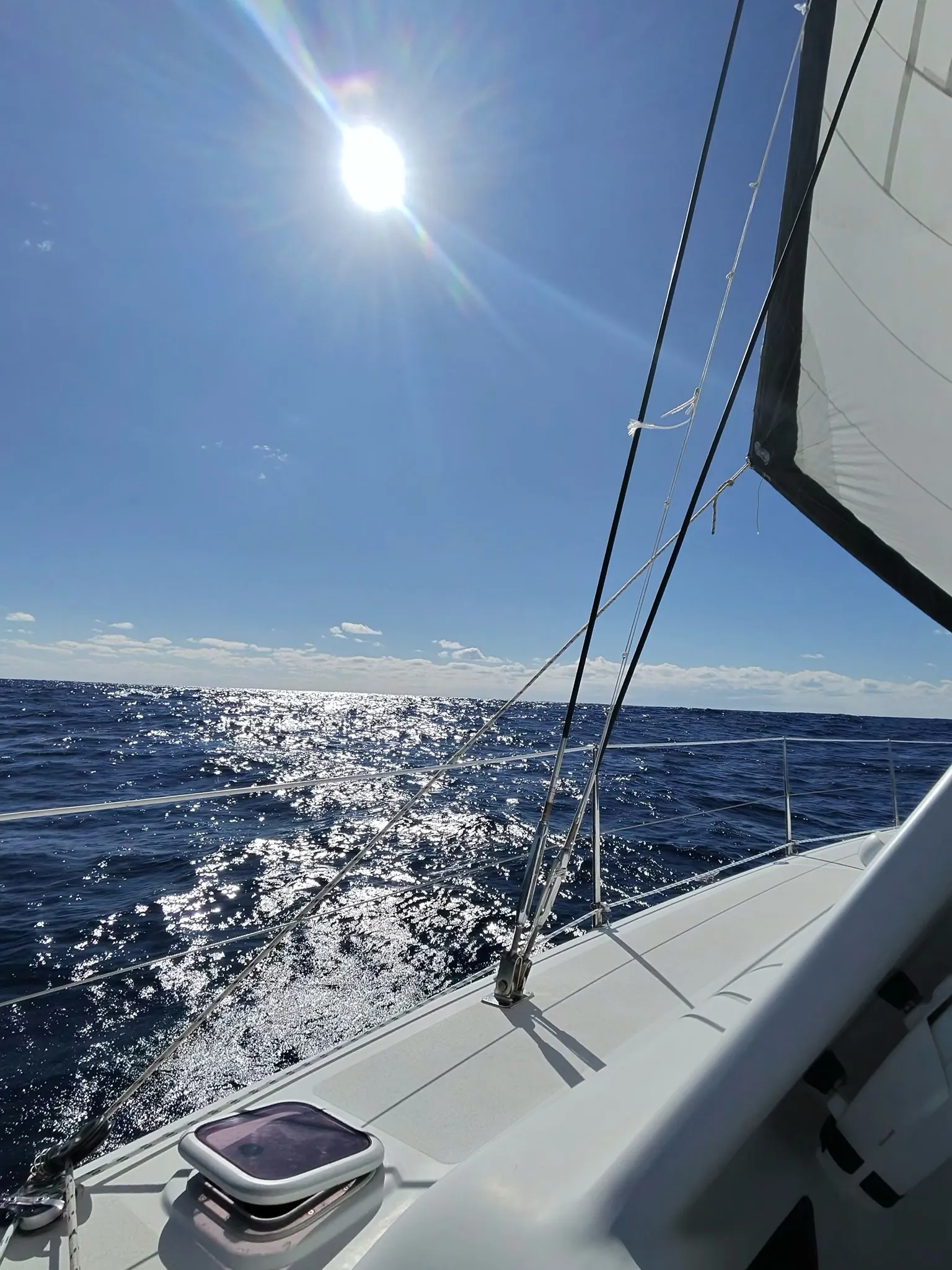
Then 4 days of what you hope for on this run: 10 to 16 knots from the east and south-east, forward of the beam, a metre of sea and the boat doing 7 to 9 knots without anyone touching anything. On the Monday we unrolled the screecher and held 9 knots most of the day. Two 24 hour runs of 155.6 and 160 miles. The engine ran on those days only to top up the batteries.
On the Tuesday the wind went to 4.3 knots, about 300 miles out. The Fiji to New Zealand passage guide explains the usual plan: leave on the back of a high moving east and time the run through the trough zone. The price of a settled run is often light air at the bottom end. We motored, swam off the boat mid-ocean while it was flat, and kept going. Plan your fuel for the last 300 miles, not the first 300.
How the boat was run
The log notes the same set-up every day, and it's the one we'd recommend: autopilot on compass, switching to wind angle when the breeze was steady, following the plotter route, AIS on and watching targets, radar on overnight, and Starlink online for weather and the log. On the last night Ken took the first watch, I relieved him at 2300, and he was back on at 0200. The breeze went light and shifty off Northland and we gybed and changed sail plan several times to keep her moving, which is what that coast does to you at night.
If you're working out a watch system for 4, the watch rota tool builds one, and the reefing guide has the wind speeds we reef at on this boat.
Clearing in at Opua
Opua Marine Park is one of the ports New Zealand Customs approves for a first arrival by an overseas yacht. Here's how ours went, then the rules as Customs and MPI publish them.
- 0630 alongside the quarantine dock. Nobody goes ashore until you're cleared.
- 0830 Customs aboard. Passports and the paperwork from the Fiji end. Have your outward clearance from your last overseas port with the boat papers, because they ask for it.
- Next the detector dog, then the MPI biosecurity officer, who went through the boat and took the food that isn't allowed in. That included sealed packets of instant noodles with pork in them.
- 1130 fully cleared, 5 hours after we tied up. Then a short sail up the Bay of Islands to the swing mooring in Kerikeri.
The rules, from the New Zealand Customs page for small craft: send the Advance Notice of Arrival at least 48 hours before you enter New Zealand waters (12 nautical miles off the coast), ideally before you leave your last port. Fly the Q flag from the 12 mile limit until you're cleared, call Maritime Radio when you reach New Zealand waters, and stay aboard until border staff clear you. The MPI biosecurity steps for yachts cover the clean hull requirement, and the officer removes prohibited food and garbage on arrival. Rules change between seasons, so check both official pages before you leave Fiji.
What we'd do the same, and what we'd change
- Same: leave on a breeze, reef for the first night before it arrives, and accept the engine at the end. The fast middle of the passage is what makes up for the calm.
- Same: the swim and hull scrub in Fiji before leaving. MPI wants a clean hull and Fiji water is the place to do it.
- Change: eat or bin anything with meat in it before the last day. We knew the rule and still lost the noodles.
- Change: one folder for every clearance document from both ends. Customs asks, and looking for paper at 0830 after a night watch isn't fun.
We haven't written this up as a guide to the route. The route and weather windows are in the passage guide above, how far to trust a long-range forecast is in the climatology and forecasting guide, and when to go is in the South Pacific cyclone season plan. This is what happened on one run, in one year, on one boat.
Where she is now
Mā Tori is back on her swing mooring in Kerikeri, Bay of Islands, with 4 seasons between New Zealand and Fiji behind her. She's for sale and viewable in Kerikeri, and if you want to do this passage yourself before you buy a boat for it, the crew passages page explains how that works.
Questions people ask about sailing from Fiji to New Zealand
How long does it take to sail from Fiji to New Zealand?
Our 2026 run from Port Denarau to Opua took 7 days and about 1,050 nautical miles on a 40 foot catamaran, with daily runs of up to 160 miles. A monohull or a run with more calm takes longer, and most cruising boats plan on 7 to 10 days.
What happens when you arrive at Opua by yacht?
You tie up at the quarantine dock and stay aboard. Customs checks passports and your clearance from the last port, a detector dog may come aboard, and an MPI officer inspects the boat and removes prohibited food and garbage. Ours took 5 hours from tying up to full clearance.
Do you have to tell New Zealand Customs before you arrive?
Yes. New Zealand Customs requires an Advance Notice of Arrival at least 48 hours before you enter New Zealand waters, 12 nautical miles from the coast, sent to Customs by email with the passports and boat registration. Check the current Customs small craft page before you leave.
What food do they take off yachts arriving in New Zealand?
MPI removes prohibited food and garbage at the inspection. On our arrival that included sealed instant noodles that contained pork. The safest plan is to eat or dispose of meat products before you arrive and check MPI's current guidance for yachts.
Keep reading: the route, weather windows and squash zones for the same passage, and the bluewater catamaran for sale that sailed it.