
Half a million US dollars sounds like a lot of boat money — and it is — but in the catamaran world it puts you at a genuinely interesting crossroads. You're below the price of almost every new production cat worth crossing an ocean in, yet squarely in the territory of excellent used boats. Spend it well and you get a capable, comfortable home that takes you anywhere. Spend it badly and you get a tired charter veteran with a fresh polish and a five-year refit bill. Every cruising catamaran for sale under this ceiling sits somewhere on that spectrum — and a cheap bluewater catamaran is usually only cheap until the survey comes back.
We've been through this exact search ourselves, then spent four seasons sailing the result between New Zealand and Fiji. Here's the honest map of the territory — including the corners of the market most lists ignore. Two principles first: the best cruising catamaran under $500k isn't a badge, it's the individual boat in front of you; and the best catamaran for ocean crossing is the one whose systems have already crossed one.
What $500k actually buys in 2026
Rough rules of thumb, in US dollars, for boats that are genuinely ready to cruise (not project boats):
| Option | Typical price | Age you'll get | What you're really buying |
|---|---|---|---|
| Used Lagoon 42 | ~$400–650k | 2016–2021 | The world's most popular cat: space, resale liquidity, often ex-charter |
| Used Leopard 40/42 | ~$300–550k | 2009–2020 | Robertson & Caine toughness, charter heritage, big service network |
| Used Fountaine Pajot (Lucia/Isla 40) | ~$400–600k | 2016–2021 | Modern French styling, light-ish build, strong brand demand |
| Used Bali 4.0/4.1/4.2 | ~$350–550k | 2016–2021 | One-level living concept, huge social space, charter-oriented |
| Older Nautitech (40/44) | ~$250–450k | 2000s–2015 | A drivable, sailor's production cat — aft helms, good manners |
| Refitted owner-built / kit cat (e.g. Fusion 40) | ~$200–350k | 2000s hull, recent refit | The most capability per dollar — if the survey is good |
Two things jump out. First, at this budget, every production option is a used boat — usually with charter history. Second, the owner-built column buys the same cruising capability for $150–300k less, which is either a trap or the smartest money in the market depending entirely on the individual boat. More on that below.
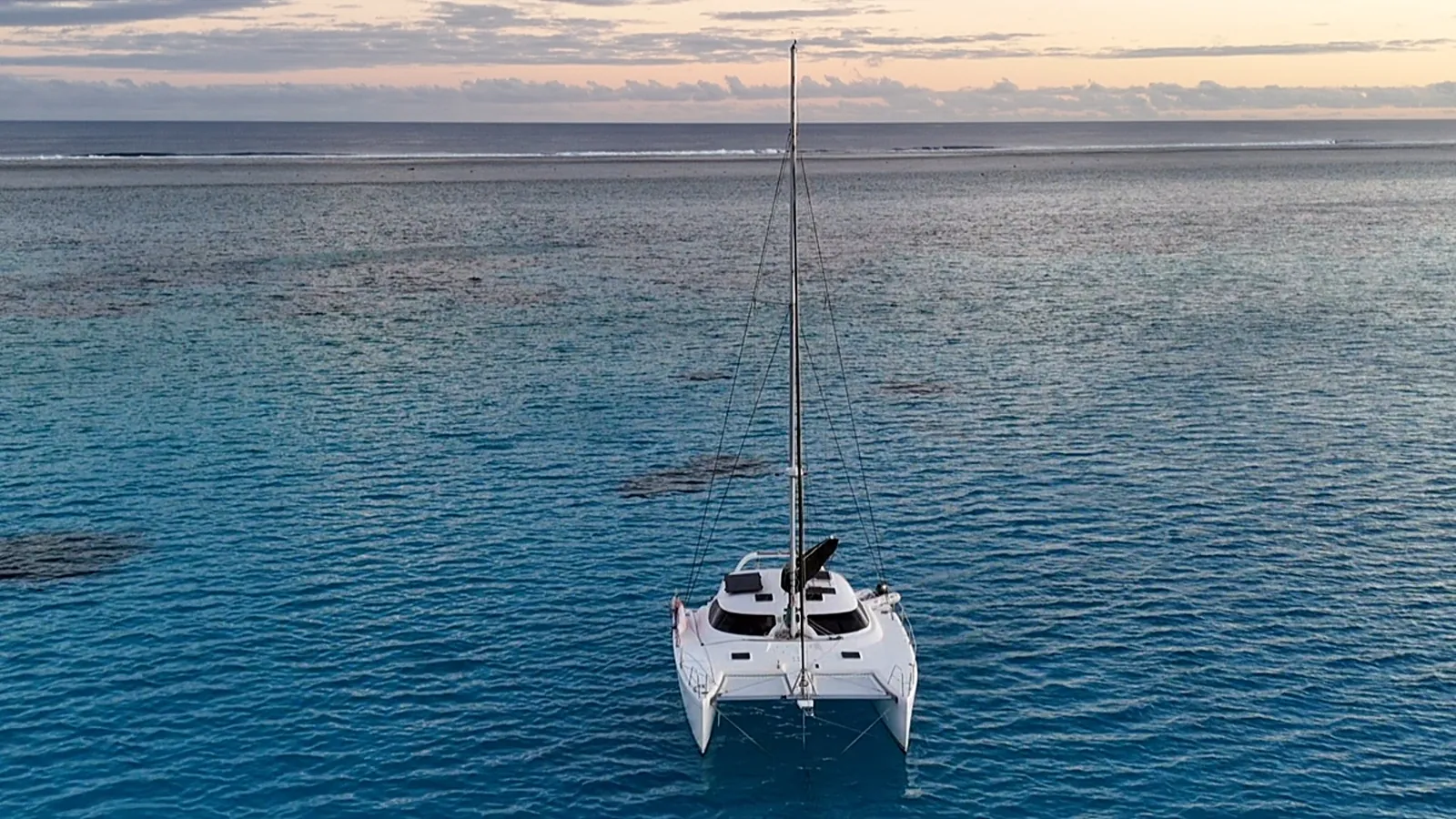
The production contenders
Lagoon 42 — the default choice
There's a reason the anchorages of the world are full of Lagoon 42s: enormous interior volume, a self-tacking jib, and a global brokerage machine that makes buying and selling painless. The trade-off is weight — around twelve tonnes lightship — which means modest light-air performance and engines that work hard. Ex-charter examples dominate the sub-$500k end; insist on a full mechanical survey and budget for rigging, batteries and sails if they're original. If family space and resale liquidity top your list, it's a rational default. Our detailed Fusion 40 vs Lagoon 42 comparison digs into the numbers.
Leopard 40 — the honest workhorse
Robertson & Caine build boats to survive charterers, which is its own kind of quality control. Older Leopard 40s (2005–2009) now sit comfortably under $350k, and later ones creep toward the top of the budget. They're solid, well-supported and unpretentious. Check engine hours honestly — charter boats motor a lot — and see our Fusion 40 vs Leopard 40 guide for what surveys typically flag.
Fountaine Pajot Lucia 40 / Isla 40 — the stylish middle
FP's 40-footers are lighter than the Lagoon equivalent, pleasant to sail and hold value well. The Isla 40 (from around 2019) is usually just above this budget unless it's led a hard life; the Lucia 40 (2016–2019) fits nicely. Interiors are lovely; tankage and energy systems usually need upgrading for full-time cruising. Comparison here: Fusion 40 vs Isla 40 & Astrea 42.
Bali 4.0–4.2 — the apartment that sails
Bali's solid foredeck and garage-door saloon create indoor-outdoor living no other brand matches. At anchor in the Whitsundays or the BVI, it's brilliant. Offshore, the same choices — weight, windage, one-level openness — are compromises. Know which sailor you are. We've written more in Fusion 40 vs Bali Catsmart.
Nautitech 40/44 — the sailor's sleeper
Often overlooked, older Nautitechs (pre- and early-Bavaria era) are among the best-mannered production cats afloat: aft twin helms that make you feel connected to the boat, moderate weight, and sensible engineering. A well-kept 2000s Nautitech 40 in the $250–350k range is one of the quiet bargains of the market — the catch is simply that you'll rarely find a Nautitech 40 for sale at any given time. Outremer and Catana play in the same performance-minded space, but even elderly examples rarely dip under $500k; if you find one that does, survey the daggerboard cases carefully and move fast.
The corner of the market the lists ignore
Here's the part we know best, because we live it. Alongside the production brands there's a fleet of professionally-designed, owner- or yard-completed catamarans — Fusion, Schionning, Grainger and Lightwave from Australia, plus one-off designs from naval architects like Gary Lidgard. These boats were typically built lighter and stiffer than charter-spec production cats, by people who intended to cross oceans in them.
The market prices them at a steep discount because build quality varies boat-to-boat and there's no brand brochure to lean on. That's real — and it's exactly why the good ones are the best value under $500k. The answer isn't faith; it's a rigorous survey. A surveyor can tell you what a specific hull is actually like, and on an owner-built cat you're buying the boat in front of you, not the badge. Our full guide to owner-built vs production catamarans covers how to evaluate one properly.
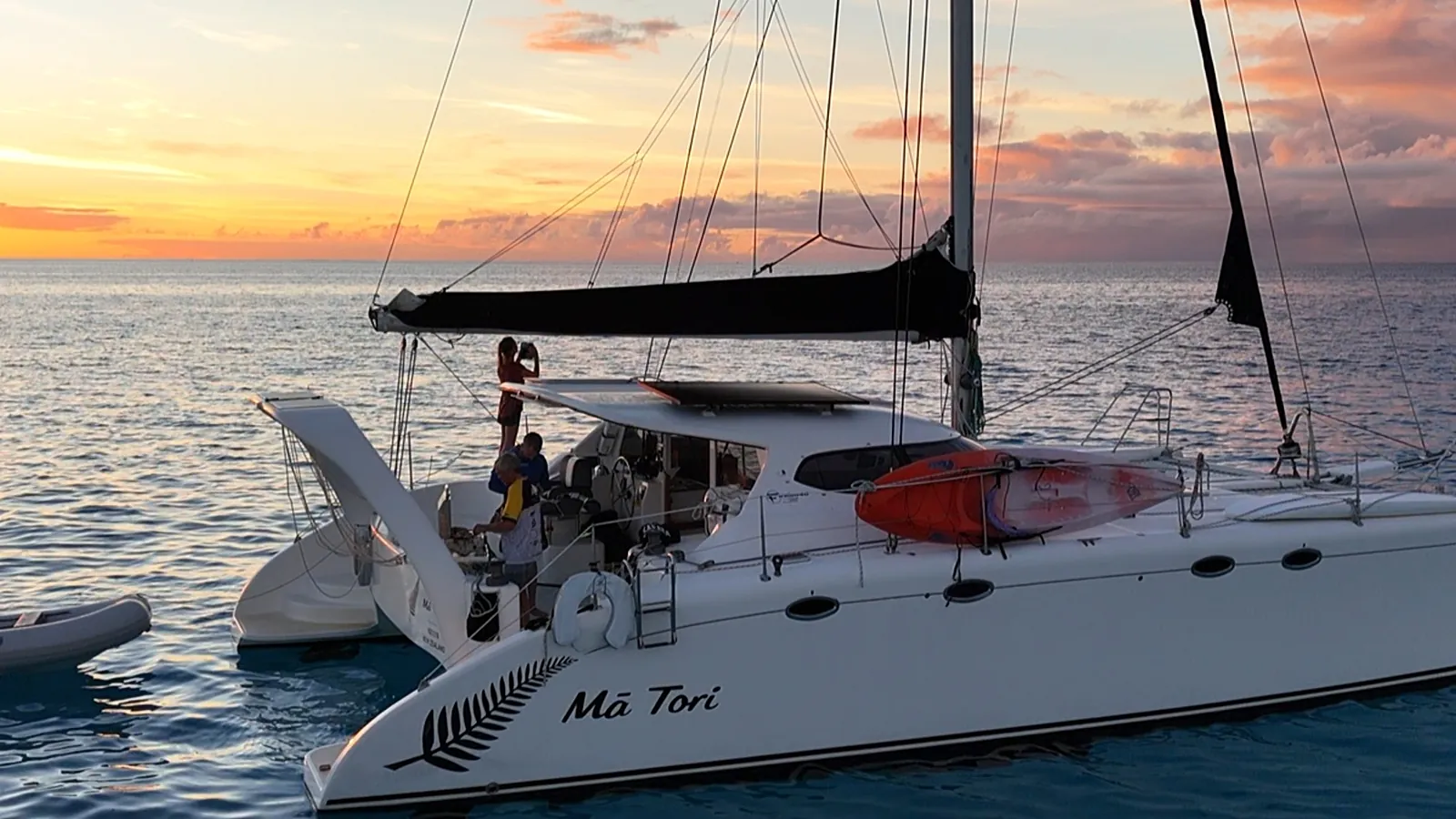
What does that discount buy? Take a refitted Fusion 40: around ten metres less displacement-per-metre than the equivalent Lagoon, 1.1m draft that opens up half the anchorages of the Pacific, and — in the case of a boat like ours — a 2022 refit, new sails, lithium, solar, a watermaker and current NZ Category 1 offshore certification for roughly the price of a fifteen-year-old ex-charter boat before its refit.
How to choose: three questions
1. Charter income or full-time cruising?
If the boat needs to earn, buy the brand the charter companies buy — Lagoon, FP, Bali, Leopard. Management companies want standard boats, and your exit buyer will too. If the boat is your home and passage-maker, that logic inverts: you're paying a premium for charter DNA you don't need.
2. Marina life or on the hook?
Marina-based sailors can treat energy systems as an afterthought. Full-time cruisers can't: solar, lithium and a watermaker transform life aboard, and retrofitting them onto a used production boat typically costs US$40–70k done properly. A boat that already has them — done and debugged — is worth real money.
3. How much do you care about sailing?
All these boats will get you there. But there's a genuine difference between a cat that needs fifteen knots to wake up and one that makes seven knots in twelve knots of breeze. Lighter boats also carry less momentum into bad decisions — something we've come to appreciate threading Fijian reef passes.
The bottom line
Under $500k, you're choosing between newer-and-branded (used production, probably ex-charter, budget for upgrades), older-and-driveable (Nautitech and friends, if you can find one), and refitted-and-proven (the owner-built fleet, where the survey is your brand). None of these is wrong. But if your plan is genuine cruising — oceans, anchorages, independence — put the refitted owner-built boats on your shortlist and judge them boat-by-boat. The best value in the catamaran market lives there, wearing no badge.
Keep reading: our full Fusion 40 review, the case for buying your catamaran in New Zealand, or go straight to Mā Tori, our bluewater catamaran for sale. One more line for the budget: where a boat was built now changes what she costs to land in the States — see US boat import tariffs.