
The Leopard 40 is one of the most sensible used catamarans money can buy, and any honest comparison has to start there. We sail — and are currently selling — a Fusion 40, so we have an obvious horse in this race. But we've also spent plenty of time around Leopards in Pacific anchorages and haul-out yards, and if a friend told us they'd bought a well-surveyed Leopard 40, we'd congratulate them without a flicker of hesitation. The question this article tries to answer isn't "which boat is better" — it's which boat is better for you, at your budget, for the sailing you actually plan to do. Plenty of Leopard 40 reviews cover the brochure; fewer cover the survey — that's the gap this one fills.
Robertson & Caine: charter DNA, and why that cuts both ways
Leopards are built by Robertson & Caine in Cape Town, South Africa — one of the world's most prolific catamaran builders — and the brand's history is inseparable from the Moorings and Sunsail charter fleets. Most Leopard 40s started life earning their keep in charter, and a large share of the used boats on the market are ex-charter phase-outs — and an ex-charter Leopard catamaran is a different proposition from a one-owner private boat.
Sailors sometimes say "ex-charter" like it's a slur. It shouldn't be. Charter DNA means the boats are engineered to survive hundreds of inexperienced crews: systems are simple, robust and accessible, decks are laid out so nobody gets hurt, and everything from the anchor windlass to the heads is specced for abuse. Charter companies also maintain boats on rigid schedules because downtime costs revenue — so ex-charter Leopards usually come with thorough, documented maintenance logs that many private boats can't match. The trade-offs are equally real: engine hours are typically high (often 4,000–6,000-plus on a phase-out), interiors show cosmetic wear from years of holiday traffic, and the inventory is charter-spec — minimal solar, small battery banks, no watermaker, basic electronics — because charter boats live a week from a marina.
The Fusion 40 comes from a completely different world. Gary Lidgard designed it as an Australian kit/modular performance cruiser; around 60 were built, finished by yards or capable owners, and essentially all of them have only ever been private boats. No two are identical — which makes surveys matter more — but the good ones were finished with a level of care no production line schedules time for.
Hull design and performance
The Leopard 40 (in both its generations) is a moderate, seaworthy design with genuine bluewater credentials — Leopards routinely cross oceans on delivery from Cape Town, which is no gentle proving ground. It carries good load, tracks well and behaves predictably. It is not, and doesn't pretend to be, a light boat: expect a laden displacement well into double-digit tonnes, with performance to match — solid trade-wind passages in the 140–170-mile-a-day range, and engines on early once the breeze drops below about 10 knots.
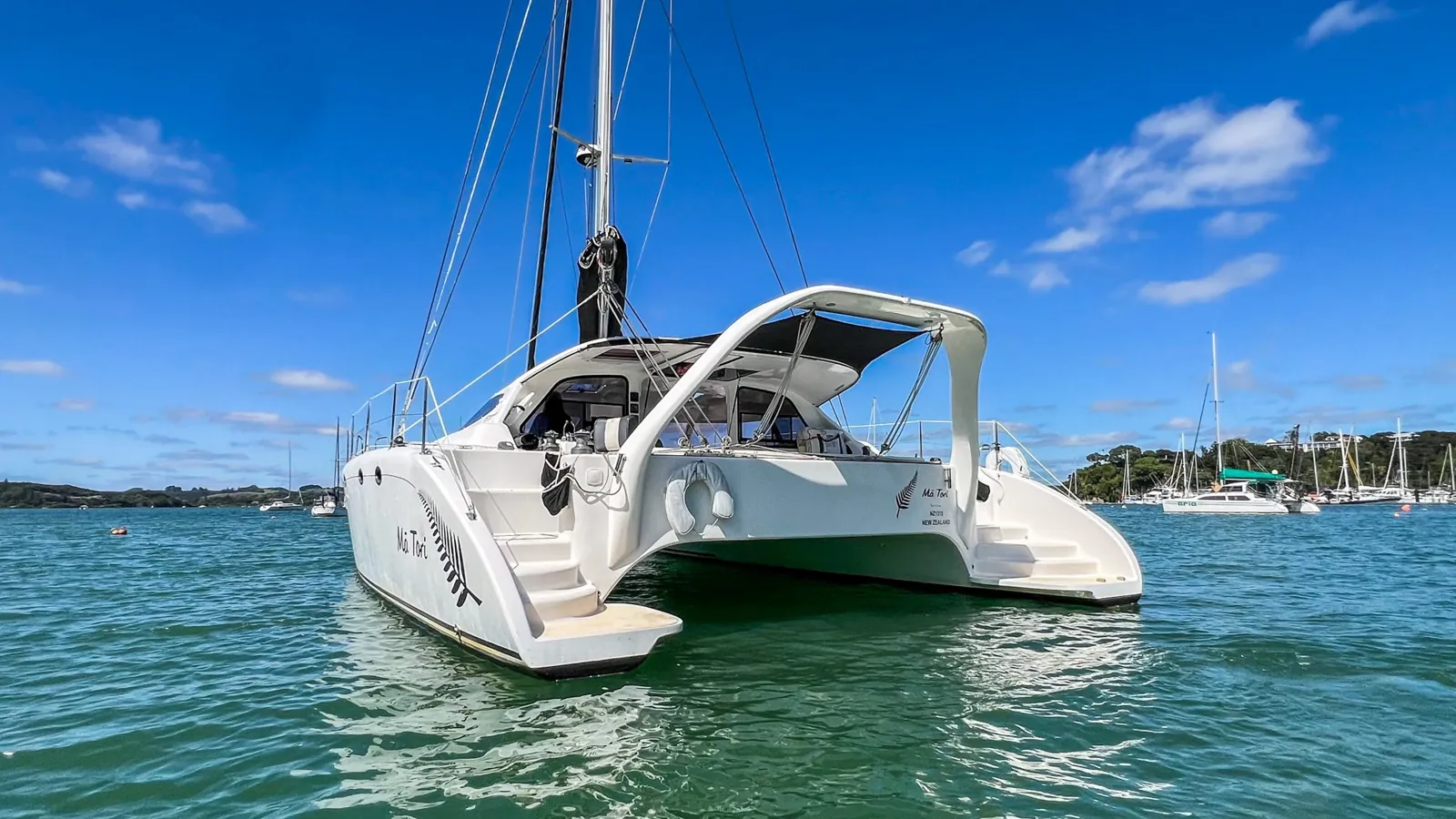
The Fusion 40 was drawn to a different brief: light displacement, fine entries and an easily driven hull. Her topsides are resin-infused foam-sandwich in vinylester resin over solid fibreglass below the waterline — a stiff, light, osmosis-resistant recipe that compares well with production polyester layups of the same era. The practical result is a boat that keeps sailing in single-digit wind speeds, points respectably, and asks less of her rig, her hardware and her engines because there's simply less boat to push. With only 1.1 metres of draft she'll also sneak into reef anchorages and dry out for a scrub in places a deeper cat can't follow.
To be fair in both directions: the Leopard's extra mass buys a steady, reassuring motion and huge load-carrying ability — you can fill a Leopard with a family's worth of gear and barely notice. A light cat like the Fusion rewards discipline about weight; load her like a removal van and you'll sail away much of her advantage.
Head-to-head specifications
| Spec | Fusion 40 (Mā Tori) | Leopard 40 |
|---|---|---|
| LOA | 12.2 m | Around 12.2 m |
| Beam | 7.0 m | Around 6.7 m |
| Draft | 1.1 m | Around 1.3 m |
| Displacement (approx.) | Light for her size — performance-cruiser territory | Typically in the region of 10–12 t, more laden |
| Cabins | 3 queen cabins (owner's hull to port) | 3-cabin owner's version or 4-cabin charter version |
| Engines | Twin Yanmar 3YM30 29 HP saildrives | Typically twin 29–45 HP saildrives depending on generation |
| Typical used price | USD $299,000 fully refitted, Cat 1 | Typically around US$300k–550k depending on year and generation |
| Offshore setup notes | Cat 1 certified; watermaker, 700W solar, 540Ah lithium, Starlink + Iridium fitted | Proven ocean-crossing pedigree; ex-charter boats usually need solar, lithium, watermaker and comms added for cruising |
The forward cockpit debate
Newer-generation Leopard 40s have the brand's signature feature: a forward cockpit reached through a door in the saloon's forward bulkhead. Owners either love it or they don't. In its favour — and we'll happily concede this — it's a glorious space at anchor: shaded, breezy, private, with the view the aft cockpit never gets. It also gives direct access to the foredeck without going around the side decks.
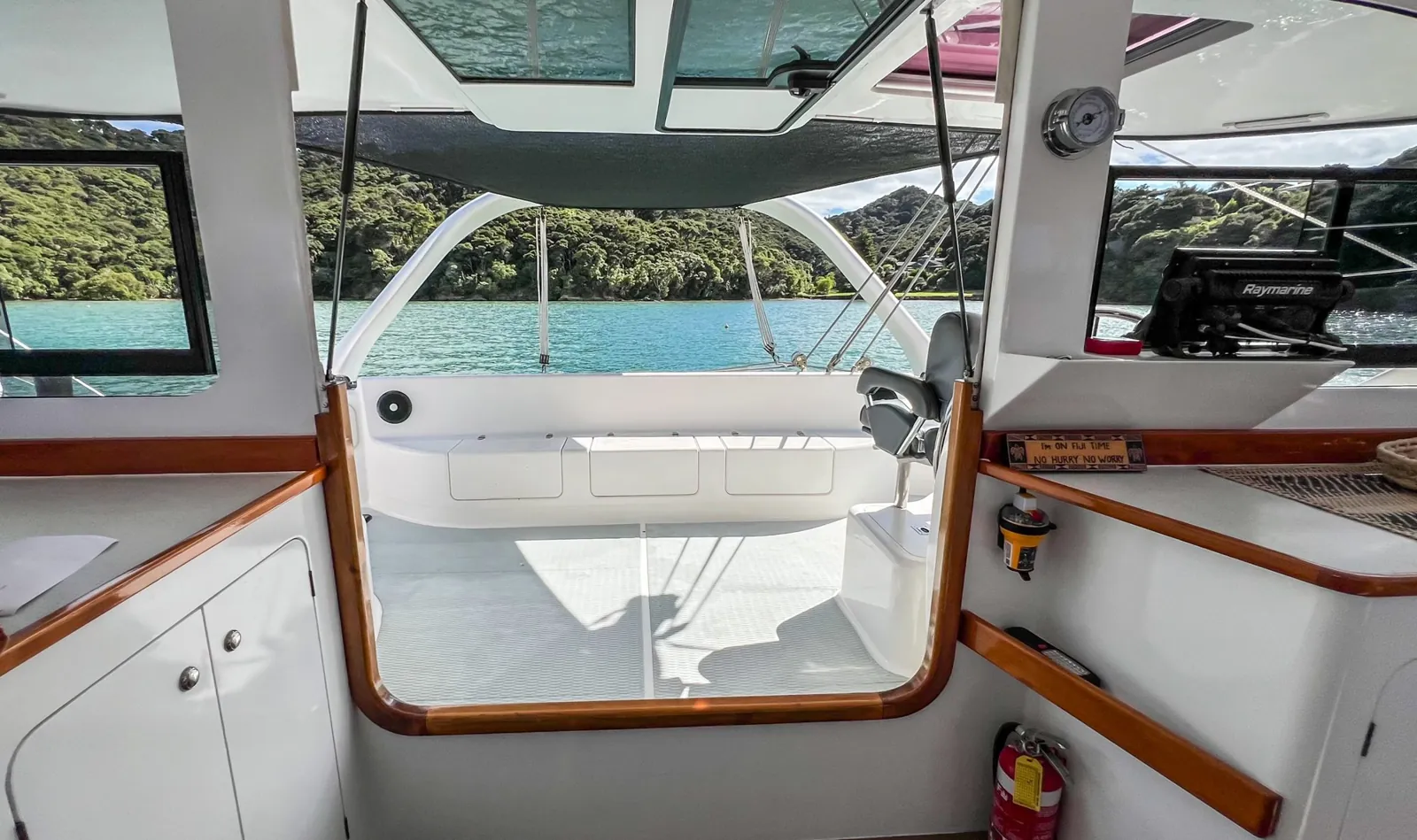
The counterarguments are worth hearing too. A door and opening bulkhead on the forward face of the saloon is one more large aperture facing the weather on an ocean passage, and some bluewater sailors simply prefer an unbroken structure forward. The forward cockpit also consumes volume and adds weight and complexity. Plenty of experienced Leopard owners cross oceans with the forward door and think nothing of it — the boats are engineered for it — but if you're the belt-and-braces type, it's a legitimate thing to weigh. The Fusion 40 takes the conventional approach: solid structure forward, one big protected aft cockpit that flows into a panoramic saloon. Less novel, arguably more conservative offshore.
Three cabins or four?
Most ex-charter Leopard 40s are four-cabin, four-head boats — brilliant for chartering, less so for a liveaboard couple, because you sacrifice the owner's hull to a second pair of guest cabins and every locker is a cabin that could have been storage. The three-cabin owner's version, with a full owner's hull, is the one private buyers hunt for, and it commands a premium because there are fewer of them.
The Fusion 40's layout answers this differently: three cabins, each with a genuine queen berth — unusual in a 40-footer. Mā Tori's owner's hull to port has an electric head and separate shower, and the third queen means guests or crew never draw the short straw. If your shortlist is "owner's-version Leopard 40 or a Fusion 40", the layouts are closer in spirit than the brochures suggest; if it's a four-cabin charter phase-out, the Fusion's interior will feel considerably more like a home and less like a floating hotel corridor.
Construction and ownership costs
Robertson & Caine build to a proven production recipe, and the boats are demonstrably tough — the Cape Town delivery miles alone prove that. Parts, dealer support and yard familiarity are excellent almost everywhere in the world; newer boats may carry remaining factory warranty, which no twenty-year-old owner-finished boat can offer. Those are real, bankable advantages.
Running costs tell a subtler story. A heavier boat wears everything faster: bigger engines burn more diesel and cost more to service, bigger sails cost more to replace, higher rig loads mean more expensive hardware, and more volume means more marina metreage in some ports. The Fusion 40's twin Yanmar 3YM30s are small engines pushing a light hull — cheap to service, frugal on fuel, and adequate precisely because the boat doesn't need more. Her vinylester foam-sandwich construction has also aged well where same-era polyester boats sometimes show osmosis. The honest caveat on the Fusion side: with roughly 60 boats built, parts are generic rather than branded (mostly a good thing), but there's no factory to ring, and a surveyor unfamiliar with the type will need to assess the individual boat on its merits rather than its badge.
What the survey will find: ex-charter vs owner's boat
Survey an ex-charter Leopard 40 and the report usually rhymes: high engine hours (though hours on well-maintained diesels matter less than neglect does), worn cabin soles and upholstery, gelcoat chips and dock rash, tired standing rigging approaching replacement age, charter-grade batteries and electronics due for renewal. Against that, the maintenance log is often immaculate and the big structural items are usually sound — charter companies fix structure because they must.
Survey a privately owned boat like a Fusion 40 and the profile inverts: lower hours and gentler cosmetic wear, but everything depends on the particular owner's standards, and the paper trail varies from obsessive to non-existent. This is why we're transparent about Mā Tori's record: full refit and relaunch in 2022, new sails 2022, antifoul June 2026, OceanF10 watermaker added 2025, and NZ Cat 1 certification — an inspection regime for offshore departure that has no real equivalent in most charter fleets — renewed across four consecutive NZ–Fiji seasons from 2023 to 2026. Whatever boat you buy, in either camp: pay for the good surveyor, open every hatch, and price the survey findings into your offer.
Price for capability
Used Leopard 40s typically run from around US$300k for older or well-used ex-charter examples to US$550k or so for late-model owner's versions. Then add the cruising conversion most ex-charter boats need — solar arch, lithium, watermaker, offshore comms, often rigging and sails — and a US$350k purchase becomes a US$420k+ project a year later. A Fusion 40 like Mā Tori at USD $299k with all of that already installed and proven over four offshore seasons is, we'd argue, the strongest capability-per-dollar in this comparison. The Leopard's counter-argument is equally honest: its resale market is far deeper. Leopards sell quickly through a worldwide brokerage network; a Fusion takes longer to sell to a more specialised buyer. You may pay for liquidity, but liquidity is worth paying for if your plans might change.
If you're also looking at the bigger sisters
Many buyers cross-shop the Leopard 45, 50 and 53. They're impressive boats — more volume, more speed under power, flybridge options — but be clear-eyed that they're a different budget class, typically US$700k to well over a million for recent examples, with haul-outs, sails, rigging and marina bills scaled to match. If a 40-footer does the job, the difference buys a decade of actual cruising.
So which bluewater cat for your budget?
Buy the Leopard 40 if: you want the security of a major builder, worldwide parts and brokerage support, and possible warranty; you like the forward cockpit lifestyle; you may put the boat into charter management to offset costs; you value fast, predictable resale; or you're carrying a big family and their gear, where the Leopard's load-carrying and four-cabin option genuinely shine.
Buy a Fusion 40 if: you're a couple or small crew who wants a boat that sails on light air rather than motoring through it; you value shallow draft, modest running costs and three real queen cabins; and you'd rather spend USD $299k on a boat already refitted, certified and proven offshore than buy a phase-out and fund the conversion yourself. Neither choice is wrong. One is the sensible global commodity; the other is the sailor's boat at the sharper price. We know which one we chose — and why we'd choose it again.
Keep reading: our full Fusion 40 owner's review goes deeper on the boat itself, owner-built vs production catamarans unpacks the build-quality question properly, and buying a catamaran in New Zealand covers the practical side of a purchase down here. Or go straight to Mā Tori, our NZ-based Fusion 40 for sale and see what USD $299k actually buys. Leopards are South African-built, which changes the US import maths — see US boat import tariffs.
Still shortlisting? The same head-to-head against the other three boats on most buyers' lists: Fusion 40 vs Lagoon 42 (the volume-versus-performance one), Fusion 40 vs Fountaine Pajot Isla 40 and Fusion 40 vs Bali Catsmart.