
The Seawind 1160XL was one of the new sailboats at the Newport International Boat Show in September, and a few stands away the Facnor TackFurl took the show's Best Innovation Product award. What changed from the original Seawind 1160, how the XL went in 30 knots off Newport, what one costs, why it ends up next to the Fusion 40 on a buyer's shortlist, and what a furler that tensions the luff from the tack would change on a cat with one winch in the cockpit. We were not at Newport and have not sailed an XL or used the furler.
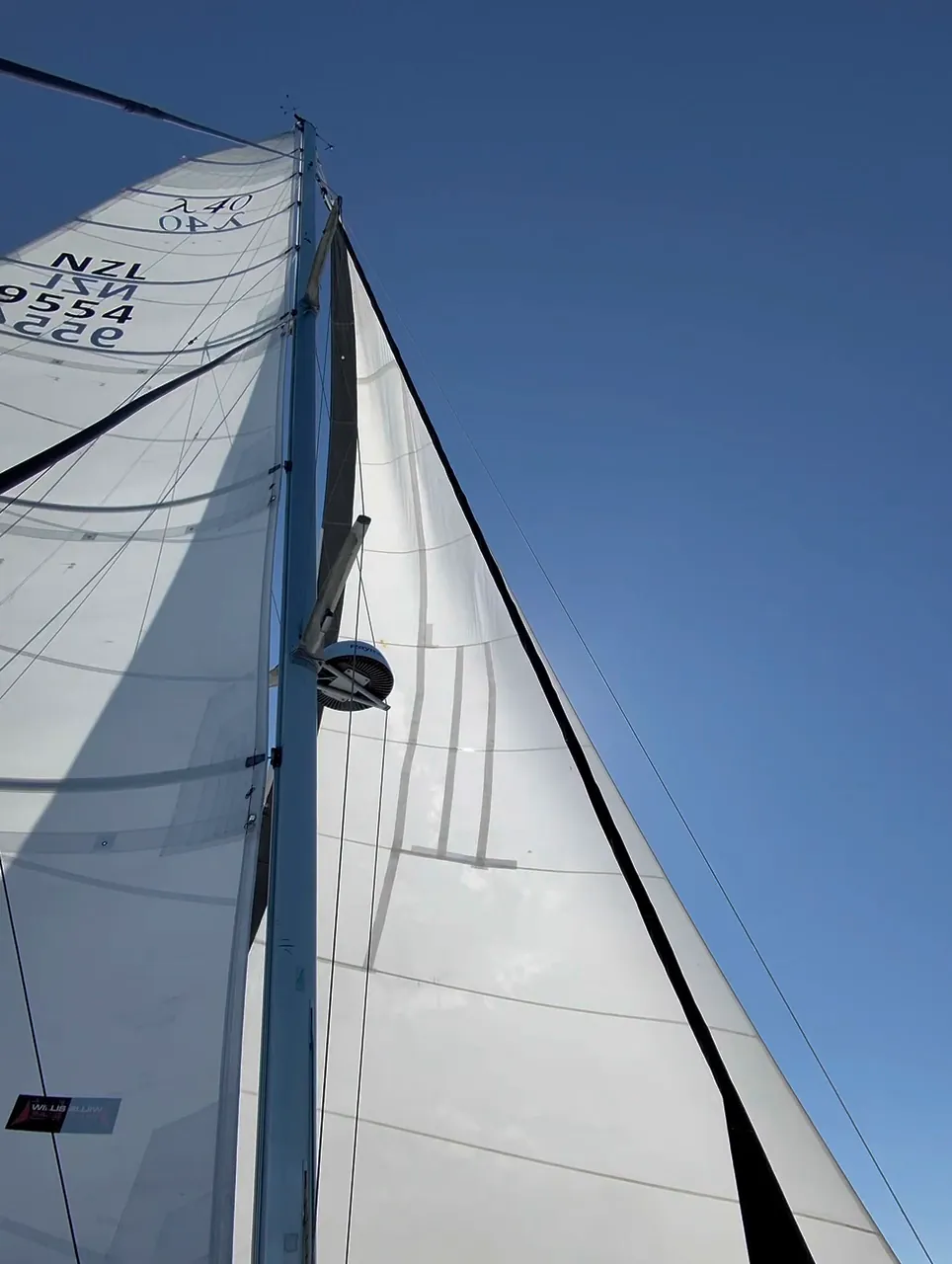
What the Seawind 1160XL is
The third version of a boat Seawind has built since 2004. On Seawind's 1160XL page the figures are 11.83 m overall, 6.6 m beam, 1.29 m draft, 7,800 kg displacement, an 18.2 m mast, 87 square metres upwind, 269 litres of fuel and 700 litres of water. Three cabins, twin helms on cable steering, the tri-fold door, infused vinylester over PVC foam, ISO Category A, and twin Yamaha 25 hp outboards as standard with diesels or a hybrid as options (SAIL says about 60 per cent of owners take outboards). The hull rework is credited to Stuart Bloomfield with Seawind's own team.
It is not new to the world. Multihulls World's 1160XL preview has the premiere in Singapore in April 2025 and the Australian launch press release put it at the Sydney show that November. Newport, 17 to 20 September 2026, looks to be the US showing, and SAIL's Newport show report does not call it a debut.
What changed from the original 1160
Seawind lists more than 30 changes. The ones that matter at sea, with the 2004 boat's numbers from the Practical Sailor used boat review:
| Figure | Seawind 1160 (2004) | Seawind 1160XL |
|---|---|---|
| Length overall | 11.60 m | 11.83 m (+180 mm) |
| Beam | 6.50 m | 6.6 m (+120 mm, 60 mm per hull) |
| Draft | 1.10 m | 1.29 m on Seawind's page, 3 ft 8 in (about 1.12 m) in SAIL's review |
| Displacement | 7,000 kg | 7,800 kg |
| Upwind sail area | 75 square metres | 87 square metres |
| Standard engines | Twin Yanmar 30 hp saildrives | Twin Yamaha 25 hp outboards, diesel or hybrid optional |
The bows are reversed, the forward beam and trampolines are 250 mm higher and the wingdeck 90 mm higher, for more buoyancy forward and less hobby horsing in Seawind's words. The transom is wider, side decks are 60 mm wider, guardrails are four wire at 800 mm, the roof is flatter for solar and the forward beam is carbon. Multihulls World puts the self-tacking jib at about 27 per cent more area and the main at 5 per cent more. SAIL's review adds two things the spec sheet does not: two watertight bulkheads per hull in the bows for the Category A rating, and the galley moved to the starboard hull.
Two figures do not line up. Seawind and its dealer say 7,800 kg and Multihulls World printed 12 tonnes, and draft is 1.29 m on Seawind's page and about 1.12 m in SAIL. We use the builder's numbers and flag both.
How it went in 30 knots off Newport
Lydia Mullan sailed one for SAIL's Seawind 1160XL review, published 6 October 2026, in wind in the high 20s gusting low 30s, 30 knots sustained toward Block Island, waves over 10 feet. The helm saw 19 knots surfing. The bows did not bury, the rudders held when it was overpowered, and the port helm, the main driving station, gave decent feedback. The reservations are the useful part. The helm was heavy in the gusts, which she puts down to a second reef that should have gone in. And with a single winch on the starboard side of the test boat, the jib sheet had to be hand tailed to get the sail furled in that much wind. Her fix is a second winch or a different lead. Multihulls World's lighter trial had the XL at 7 to 9 knots close hauled in 20 knots. Light boat, trial day, the same caveat as our Fusion 40 review.
What a 1160XL costs
Seawind does not publish a list price. Multihull Central, Seawind's Australian dealer, advertised a factory special on a page dated 4 August 2026 at AUD 889,000 including GST, with twin 50 hp Yamaha outboards, about 1,060 W of solar, a B&G package, freight to Sydney or Brisbane and commissioning, marked sold out with early 2027 delivery offered. Diesels are extra. Used, Practical Sailor's market scan found a 2013 at USD 249,000 and a 2023 at USD 455,224.
Against our best cruising catamarans under $500k guide and the production 48 in the FP48 first look, the XL sits where Seawind says it wants it: priced against the entry level production cats, with less boat and a lot less weight.
Why the 1160 sits next to the Fusion 40 on a buyer's list
Because they answer the same brief from opposite ends. Both came out of Australian yards at around 12 metres, the Seawind from Wollongong before production moved to Vietnam in 2010, the Fusion 40 drawn by New Zealander Gary Lidgard for Fusion Catamarans. Both draw about 1.1 m. Both are light: 7,000 to 7,800 kg for the Seawind, and the Fusion 40 well under the production 40 footers of its era, which the Fusion 40 against Lagoon 42 comparison has at around 12 tonnes light ship. Both are built for a couple with lines led aft, on Mā Tori to a single electric winch in the cockpit, which is why the SAIL winch comment landed with us.
The differences are the ones a buyer decides on. The Seawind is a production boat, more than 200 built, factories in Vietnam and Turkey, a dealer network and the resale liquidity that comes with it. The Fusion 40 is a kit boat, around 60 completed by different yards and owners, and the owner-built against production guide explains why that means a harder survey and a lower price for the same boat. The Seawind runs outboards as standard. We run diesel saildrives, which cost more to service and give you a proper alternator and a prop that stays in the water in a seaway. Outboards on a cat with big solar and lithium are not the drawback they were, but it is a choice, not a free upgrade. Beam is 7.0 m on the Fusion against 6.6 m on the XL, and that 400 mm is where the Fusion's volume comes from.
On a used 1160, Practical Sailor flags tight engine access on the diesel boats, heavy steering on the early cable systems and the tri-fold door hardware. Add the cat list from the Catamaran Buyer's Pack: bulkhead tabbing, saildrive boots, chainplates and rigging age, which apply to a Fusion 40 for sale as much as to a Seawind.
The Facnor TackFurl
Facnor's TackFurl page describes a manual furler with a halyard lock built in, no top swivel and a low profile drum. Hoist the sail on a trigger line, lock the pin on a reduced diameter halyard, slack the trigger line, and the luff is ready to be pulled down. Luff tension is then set with a sliding drum and a cunningham line, which a dealer can lead to the cockpit. The tack point is adjustable. Facnor claims maximum luff tension with no mast compression from the halyard, and a patent. Technical documents are due in 2026 and there is no price on the page.
The Newport judges gave it the 2026 Best Innovation Product award, entered by Wichard Group, Facnor's parent. Lydia Mullan, a judge as well as the reviewer above, summed it up as letting sailors "tension a furling headsail from the tack" and move the drum for a better sail shape. In the SAIL show report she adds the practical bit: adjusting the drum rather than the halyard frees up a cockpit winch.
What it would change on our foredeck
It is not a powered furler and it does not touch the furling line, so it does nothing for the hand tailing problem SAIL hit on the 1160XL. What it changes is the halyard. On a conventional furler the halyard stays loaded on a winch or a clutch while the sail is up, and every time you want more luff tension in a building breeze you go back to it. With the halyard locked at the top, that winch is free and the luff is tensioned from deck level by a cunningham you can reach. On a boat with one electric winch and a passage south that can go from 12 knots to a squash zone in a day, that is worth something.
What we would want answered before fitting one. How the lock behaves after 1,100 miles of a sail furled and unfurled a dozen times with salt in it. Whether the cunningham lead chafes where it crosses the foredeck, because every extra line forward is one more thing to check on a night watch. Whether sliding the drum moves the sheet lead. And how the sail sets partly furled, since a reefed headsail is where furlers show their faults. The catamaran reefing guide has the wind speeds we work to, and a tool like this should make the next step in that table quicker, not put it off.
We have not seen a TackFurl in the flesh. Get the brochure from the dealer before you order.
What we don't know
- The TackFurl's price, load table and sail sizes. Nothing is published.
- The XL's real draft and displacement, and a list price from Seawind itself.
- How either behaves on a loaded cruising boat over a season. Every figure here is from a spec sheet or a trial day.
Prices, specifications and certification rules change. Check Seawind's and Facnor's pages, the dealer and your flag state before you rely on anything here.
Questions people ask about the Seawind 1160XL
What is the difference between the Seawind 1160 and the 1160XL?
The XL is 180 mm longer at 11.83 m, 120 mm wider at 6.6 m, with reverse bows, two watertight bulkheads per hull, a wingdeck 90 mm higher, 800 mm guardrails and a bigger rig at 87 square metres upwind. Displacement is 7,800 kg against about 7,000 kg for the original.
How much does a Seawind 1160XL cost?
Seawind does not publish a list price. Its Australian dealer advertised a factory special at AUD 889,000 including GST on a page dated 4 August 2026, with twin 50 hp outboards and about 1,060 W of solar, marked sold out with early 2027 delivery offered. Prices move with the currency, so check with the dealer.
What does the Facnor TackFurl do?
It is a manual headsail furler with a halyard lock and no top swivel. You hoist the sail, lock the halyard, then set luff tension by sliding the drum down with a cunningham line that can be led to the cockpit. Tension comes off the tack instead of the halyard, which won it Newport's 2026 Best Innovation Product award. Facnor has not published a price.
Keep reading: the other new cats this season are in the Knysna 550 preview and the Annapolis 2026 boats and kit post, and if a sorted 40 footer is closer to the brief, our bluewater catamaran for sale is the one we know.