
Overnight (25 August our time, 24 August in Washington), the trade war escalated again: the US announced 50% tariffs on Canadian cars, trucks, auto parts and steel from 1 January 2027 after talks with Ottawa collapsed, floated a fresh tariff on Chinese goods for "flooding the market", and is days from finalising an expanded list of steel, aluminium and copper products under Section 232 duties. None of that headline names boats. All of it lands on a boat-buying market that has already changed profoundly since 2025 — and if you're an American (or anyone planning to bring a boat to the US) shopping for a cruising sailboat right now, the tariff question belongs in your spreadsheet next to the survey and the rig check. Here's how it actually works, without the panic.
We're sailors, not customs brokers or tax advisors. Rates below are as reported in late August 2026 and change with startling frequency — treat this as a map, and verify the current numbers with a licensed customs broker before you sign anything.
The one rule that explains everything: tariffs follow the build, not the buyer
The US tariff on a yacht is determined by where she was built — not where you buy her, not her flag, not your nationality, and not whether she's new or forty years old. A French-built Lagoon bought second-hand in Florida from an American seller who never formally imported her still owes the French tariff when she's imported. A New Zealand-built cat bought in Auckland owes the NZ-origin rate if and when she's imported into the US. And that "if and when" is the entire game, as we'll get to.
Three corollaries worth engraving somewhere:
Used boats are not exempt. Tariffs bite at importation, whatever the boat's age. The old world — where a used boat crossed the dock for a flat 1.5% federal duty — is gone.
Duty-paid once is duty-paid forever. A boat that was previously imported into the US with duties properly paid is treated as domestic goods. A new owner can bring her back without paying again. This is why "US duty paid" has become a genuine line item of value in brokerage listings — and a document you should demand to see, not take on trust.
US-built boats carry no tariff at all. Which is precisely the policy's point, and why the used prices of American-built boats have firmed.
The current lay of the land, by country of build
| Where she was built | Indicative US tariff on import | Notes for sailboat buyers |
|---|---|---|
| United States | None | No tariff; used US-built boats increasingly sought-after |
| European Union (France, etc.) | ~10% | Reduced from 15% under the US–EU arrangement — covers most production cats (Lagoon, Fountaine Pajot, Bali) |
| Most other countries (incl. NZ) | ~15% | The broad across-the-board rate as at August 2026 |
| Australia | ~15%, but potentially 0% under AUSFTA | Goods qualifying under the US–Australia FTA rules of origin may enter duty-free — worth a broker's opinion on any Seawind or Lightwave |
| South Africa (Leopard) | Elevated — check current rate | Rates on South African goods have moved repeatedly; verify before committing |
| Taiwan | ~32% | Affects many quality trawlers and some sailboats |
| China | Up to ~54% | Includes some production cats and much of the new-boat parts chain |
On a US$500,000 catamaran, that table reads: zero if she's American-built or already duty-paid, ~US$50,000 if she's French, ~US$75,000 if she's from most of the rest of the world, and a quarter of a million dollars if she's Chinese-built. Suddenly the survey fee looks like small change.
What last night's news adds
Directly: nothing yet — sailboats aren't named in the Canada measures or the proposed China "flooding" tariff. Indirectly: three things. First, the expanded steel, aluminium and copper duties feed straight into US new-boat build costs — spars, rigging wire, engines, hardware — which pushes new-boat prices up and, with them, the used market they anchor. Second, 50% on Canadian steel and parts squeezes the North American marine supply chain from another direction. Third, and most useful to internalise: the direction of travel is up, and the reliability of any given rate is down. Nobody — genuinely nobody — can tell you what the tariff on your chosen boat will be the month your purchase settles. That uncertainty is itself now a feature of the market, and it rewards buyers whose plans don't depend on a rate staying still.
The escape hatch: tariffs only bite when you import
Here's the part that changes the strategy, and the reason this post belongs on a website about a catamaran lying in Fiji. A tariff is an import duty. A boat that never formally enters the United States never owes it — and US customs law provides a well-trodden, entirely legal route for exactly this:
Buy her abroad, flag her abroad, and cruise. An American can own a foreign-built boat, register her under a foreign flag, and sail her anywhere in the world — including US waters, temporarily, under a US Customs cruising licence. The standing conditions: you can't charter her in the US, and she must leave US waters periodically (the commonly applied rule is more than fifteen days a year outside, renewing the licence annually). No importation, no tariff. This is how a large share of the world's cruising fleet has always operated, and the tariff era has turned it from a convenience into a five-figure strategy.
Or simply... don't bring her to the US at all. If your plan is the one most of our readers are hatching — buy a capable cat and go cruising — then the tariff question answers itself. A boat bought in New Zealand that spends her life between the Bay of Islands, Fiji, Tonga and Vanuatu owes the US Treasury precisely nothing, because she never goes there. You fly to her; she doesn't sail to you. The Pacific, helpfully, is where the good-value boats already are.
The tax column: what you owe besides tariffs
US state sales and use tax is the other big line for American buyers, and it follows a similar logic: it's generally triggered by where the boat is delivered, used or kept — not by your citizenship. Buying and keeping a boat outside the US typically keeps you outside state sales/use tax as well; bringing her into your home state starts the clock. States differ enormously (some cap the tax, some don't; most have use-tax grace periods measured in days), so this is broker-and-accountant territory once your plans involve US waters.
Buying in New Zealand has its own pleasant wrinkle: GST on a boat exported by an overseas buyer can often be zero-rated or refunded, and private sales between individuals typically sit outside the GST net altogether. We've covered the mechanics, with the appropriate "get proper advice" caveats, in our guide to buying a catamaran in New Zealand.
Australia, for completeness: importing a boat there attracts GST (10%) and potentially duty, on a similar keep-her-offshore-or-pay logic. Every country plays this game; the trick is simply knowing which lines trigger on purchase and which trigger on arrival.
A worked example, close to home
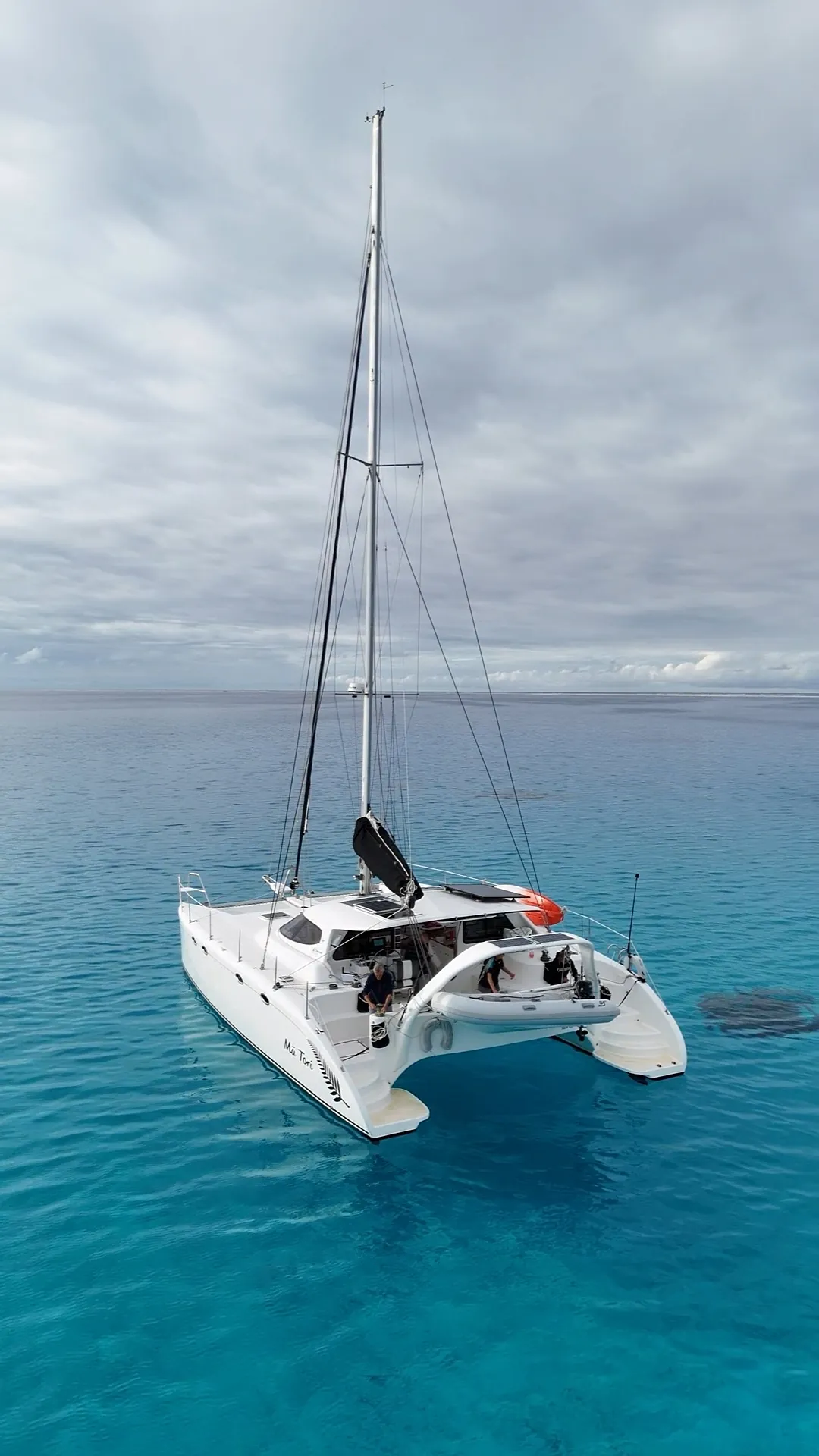
Take a US buyer looking at a US$299,000 New Zealand-built catamaran — ours, say. Imported to the States at the across-the-board rate, she'd owe roughly US$45,000 in tariff, plus shipping, plus state use tax on arrival. The same boat bought in NZ, kept on a foreign flag, and sailed on the NZ–Fiji–Tonga circuit owes: nothing. Not deferred — nothing, for as long as that's the plan. And if life changes in three years and you do want her in Chesapeake Bay, you make the import decision then, at whatever the rate happens to be, on a boat you've already had three seasons of use from. The tariff era doesn't punish buying a boat abroad; it punishes buying a boat abroad and immediately shipping her home. Cruisers were already planning to do the smart thing.
The short version
US tariffs on boats follow the country of build, apply to used boats as much as new, and currently run from zero (US-built, or previously duty-paid) through ~10% (EU) and ~15% (most of the world, NZ included) to 30–50%+ (Taiwan, China). Last night's escalation — 50% on Canadian autos, parts and steel from January, more steel and aluminium duties in the pipeline — doesn't name sailboats but pushes build costs and uncertainty in one direction. The buyer's counter-move hasn't changed since the first announcement: tariffs bite at importation, so buy where you intend to cruise, flag her sensibly, use a cruising licence for US visits, and make any import decision later, deliberately, with a broker's advice and that month's actual rate in front of you. The paperwork got heavier; the case for buying a proven boat in the South Pacific and just going sailing got, if anything, stronger.
Keep reading: the buying mechanics live in buying a catamaran in New Zealand, the connectivity half of the new-rules era is in Starlink's new rules for cruising sailors, and the market survey is best cruising catamarans under $500k. And if the worked example appealed, Mā Tori is for sale now.