
Most catamaran comparisons are between boats trying to do the same job slightly differently. This one isn't. The Bali Catsmart and the Fusion 40 sit at opposite ends of the cruising-cat spectrum — one optimised for living aboard in comfort, the other for sailing across oceans — and understanding why they diverge will tell you more about what you actually want than any spec sheet. We own and sail a Fusion 40, so read us with that in mind, but we'll be straight about what Bali does brilliantly, because it genuinely does some things brilliantly.
Bali's radical idea
When Catana Group — a builder with a serious performance-catamaran pedigree — launched the Bali range, it made a bet that most catamaran buyers don't actually want a conventional catamaran. Out went the trampoline: Bali fitted a solid, usable foredeck with sunpads and seating. Out went the fixed bulkhead between cockpit and saloon: in came a huge tilting garage-door that lifts the entire aft wall of the saloon, merging cockpit, galley and living space into one enormous open-plan room. One level, no thresholds, indoor-outdoor flow that a beach house would envy.
The Catsmart is the entry point to that idea — around 11.5 metres, typically from around €400k+ new before options — and above it the range steps up through the Bali 4.2 and 4.6 to the 5.4, each one scaling the same concept. It's a coherent ladder: buyers can start small and trade up without changing philosophy, and the charter industry has embraced the boats for exactly the qualities owners love at anchor.
Who the Bali genuinely delights
Spend an evening aboard a Bali in a marina or a calm anchorage and the concept sells itself. The living space per metre of boat is extraordinary — a Catsmart lives like a conventional 45-footer inside. The solid foredeck is a wonderful social platform. The galley and saloon work like a real apartment kitchen and lounge. For a family living aboard in the Mediterranean, a couple doing marina-based coastal cruising, or a charter group of eight who'll sail three hours a day and swim the rest, the Bali is not a compromise — it's arguably the best tool on the market. Add Catana Group's production scale, a worldwide dealer network, factory warranty on new boats and genuine charter-revenue potential, and the package is easy to recommend for that life.
What the concept costs offshore
Every design decision buys something and pays for it somewhere. The Bali concept pays offshore.
Weight. A solid foredeck, a massive glazed saloon and apartment-scale furniture all add tonnes. Weight is the enemy of catamaran performance and comfort in a seaway: a heavier cat sails further from her polars, slams her bridgedeck harder into head seas, and leans on her engines more often. Balis are honest about being motorsailers in practice — many owners are happy with that, but you should choose it knowingly.
Windage. That tall, slab-sided accommodation is glorious at anchor and a handful in 30 knots — when berthing, when anchoring in a blow, and when trying to make ground to windward.
Ventilation and the sea state question. With the garage door up, a Bali at anchor is the best-ventilated boat in the bay. Underway in weather, the door comes down and the boat becomes a large enclosed space that relies more on hatches and airflow design than an open cockpit ever would. And a solid foredeck, unlike a trampoline, doesn't let green water drop straight through — the designers compensate with buoyancy and freeboard, but the physics of taking a wave over a solid platform versus through netting are what they are.
The Fusion's opposite philosophy
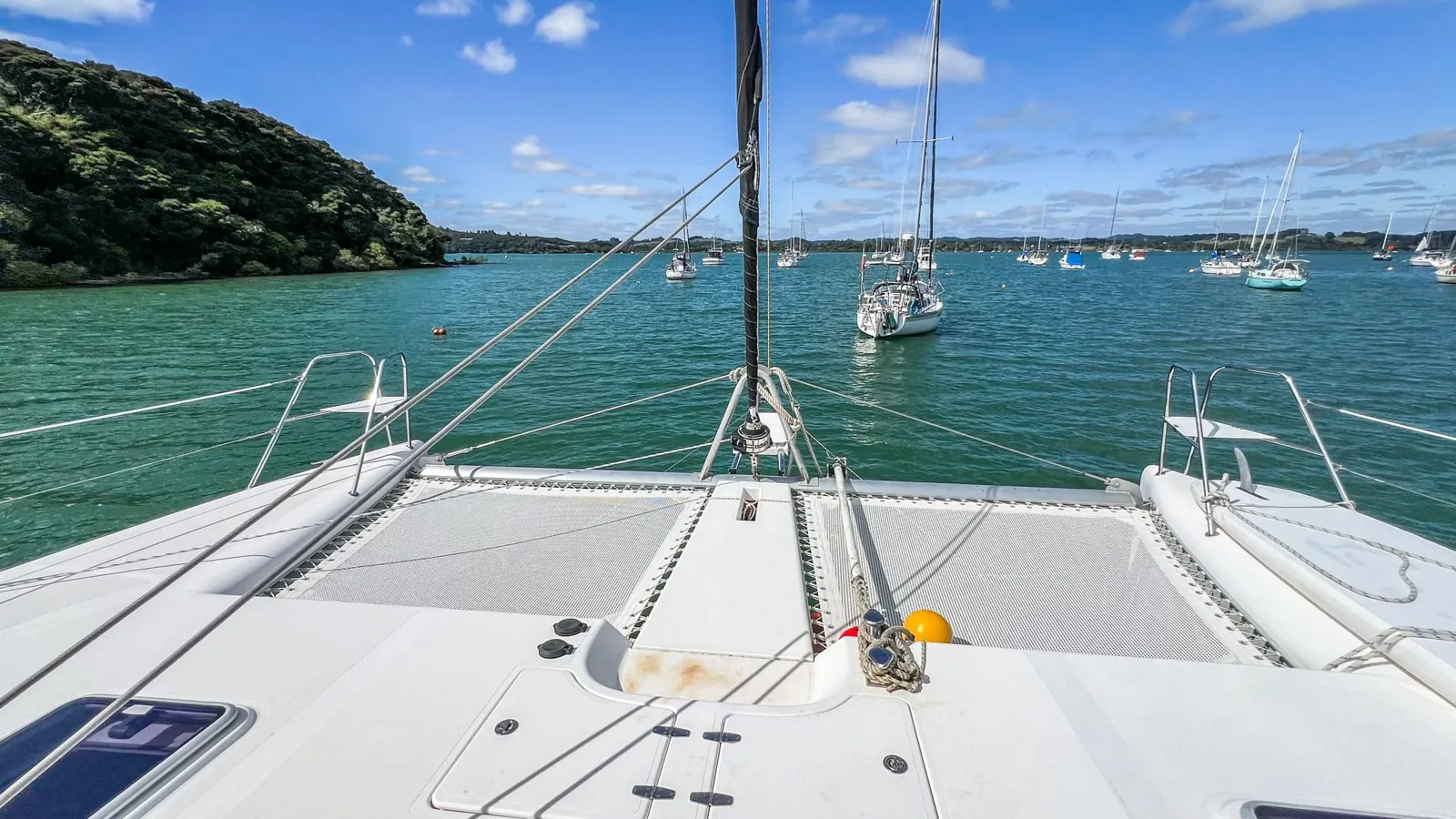
The Fusion 40, designed by Gary Lidgard and built in Australia (around 60 boats, built as kit/modular projects and finished to order), starts from the opposite premise: the boat is first an ocean-going sailing machine, and the accommodation fits around that. Resin-infused foam-sandwich vinylester topsides keep her light; solid fibreglass below the waterline keeps her tough where reefs and beaches matter. At 12.2 metres by 7.0 metres she carries real trampolines forward — waves flush through, weight stays out of the bows — and generous bridgedeck clearance, which is the single biggest factor in whether a catamaran is pleasant or punishing in a seaway. Draft is just 1.1 metres.
Light displacement means she sails in breezes that send heavier cats to their engines, and her twin Yanmar 3YM30 29HP saildrives are enough because they're moving less boat. The trade-off is exactly what you'd expect: she doesn't have a garage-door saloon or a foredeck terrace. She has three queen cabins (the owner's hull to port with electric head and separate shower), a proper cockpit, and the layout of a boat that expects to make passages.
Spec snapshot
| Spec | Fusion 40 (Mā Tori) | Bali Catsmart | Bali 4.2 |
|---|---|---|---|
| Length overall | 12.2 m | ~11.5 m | ~12.8 m |
| Foredeck | Trampolines | Solid platform | Solid platform |
| Saloon/cockpit | Conventional, open cockpit | Tilting garage door, one-level living | Tilting garage door, one-level living |
| Displacement | Light for her size | Heavy for length (concept-driven) | Heavy for length (concept-driven) |
| Draft | 1.1 m | ~1.2 m+ | ~1.2 m+ |
| Orientation | Passage-making, couple/family cruising | Liveaboard comfort, coastal, charter | Liveaboard comfort, charter |
| Price | USD $299,000 (~€275k), fully cruise-equipped | New ~€400k+ before options | New, typically well above Catsmart |
New Bali money versus refitted Fusion money
Most Bali Catsmart reviews stop at the base price. The cruising invoice is where the real story lives.
A new Catsmart starts around €400k+ before options — and options are never nothing on a production boat. Equip one for genuine independent cruising (serious battery bank, solar, watermaker, offshore comms, upgraded ground tackle) and the real number climbs well beyond the base price, plus a season of commissioning. In exchange you get a brand-new boat, a warranty, dealer support and — if you charter her — income potential. Those are real, valuable things.
Mā Tori costs USD $299,000 — around €275k — and the cruising equipment conversation is already over: 700W solar, 540Ah lithium, 2000W inverter, OceanF10 watermaker (2025), Raymarine electronics with autopilot, Starlink and Iridium, new sails in 2022, antifoul June 2026, and a 3.4m RIB with a 15HP Suzuki on the davits. More to the point, the combination has been proven the only way that counts — four consecutive NZ–Fiji round trips, 2023 to 2026, under current NZ Cat 1 offshore certification.
Who should buy which
Buy the Bali if: your cruising life is mostly at anchor or in marinas, you'll sail coastal distances in settled weather, you're chartering the boat or hosting big groups, and living space is the thing you'll enjoy every single day. Buy it new, enjoy the warranty, and don't let performance sailors talk you out of a boat that fits your actual life.
Buy the Fusion 40 if: the passages are the point — if your plans include crossing oceans or running seasonal routes like New Zealand to the Islands, if you want a boat that sails well enough to be a pleasure rather than a delivery, and if shallow draft and light displacement matter to where you want to drop anchor. If that's your list, ours is for sale.
Keep reading: the build-philosophy question gets a full treatment in owner-built vs production catamarans, our Fusion 40 review covers the design in depth, and best cruising catamarans under $500k surveys the wider market. Or head straight to Mā Tori, our Fusion 40 for sale. Balis are French-built too, which now carries a tariff cost for US buyers — see US boat import tariffs.
Still shortlisting? The same head-to-head against the other three boats buyers weigh up: Fusion 40 vs Lagoon 42, Fusion 40 vs Leopard 40 (the ex-charter question) and Fusion 40 vs Fountaine Pajot Isla 40.