
Every September, several thousand cruising boats scattered across Fiji, Tonga, Vanuatu and New Caledonia have to answer the same question: where is this boat spending the next six months? It's the biggest decision of the cruising calendar. It sets your costs, your route, your insurance validity and — in a bad year — whether you still own a boat in April.
There's no universally right answer, which is exactly why the conversation gets so heated on the dock. What there is, though, is a clear set of options with honest trade-offs, and a couple of hard constraints that decide it for most people. We've made this call four seasons running from Fiji, so here's the landscape as we see it.
The dates, and what they actually mean
The official South Pacific tropical cyclone season runs 1 November to 30 April, with activity usually peaking January through March. Those dates aren't a force field. Systems form early and late — and the fact that a cyclone has never hit a particular anchorage in living memory is a statement about history, not about this year.
What the dates really do is set the calendar that everyone else works to: insurers write policies around them, marinas fill their cyclone berths around them, haul-out yards book out around them, and weather routers plan the exodus around them. Which means the practical deadline for making your decision isn't 1 November — it's now, because the good berths and the good yard slots are being taken this month.
The constraint that decides it for most boats: insurance
Before you weigh anywhere against anywhere else, read your policy. Most cruising insurance defines a cyclone area — often as a latitude band or a named region — and requires your vessel to be outside it, or inside a specified cyclone-rated facility, by a specified date. Breach that and a claim can be declined even for damage that had nothing to do with a cyclone.
The wording varies enormously between insurers, vessels and even between renewals of the same policy, so don't rely on what worked last year or on what the boat next door was told. Read the current wording, and if anything is ambiguous — and it often is around named facilities or "laid up ashore" definitions — get clarification in writing before the season. This single piece of admin eliminates most of the options for most boats, which at least makes the rest of the decision simpler.
Your five real options
1. Sail south to New Zealand
The most popular choice, and ours. Roughly 1,100 nautical miles from Fiji, comfortably outside the cyclone belt, with a marine industry that's genuinely world-class — riggers, sailmakers, engineers and composite specialists who work on offshore boats all year and whose rates compare well with Europe or North America. It's the natural place to do a refit, and Northland's cruising ground is a reward in itself over the southern summer.
The costs: it's a real ocean passage out of the tropics at a time of year when the weather has opinions — see our guide on timing the passage south. New Zealand summer is not tropical, arrival biosecurity is strict, and there's a limit on how long a foreign-flagged boat can stay before import questions arise. For most cruisers, none of that outweighs the upside.
2. Sail south-west to Australia
Bundaberg, the Gold Coast and Mooloolaba absorb a big share of the fleet each year. Similar logic to New Zealand — out of the cyclone belt, excellent facilities, and for many crews an easier visa and cost-of-living situation. The passage from Vanuatu or New Caledonia is shorter and often kinder than the New Zealand run.
Watch two things: Queensland's own cyclone risk doesn't vanish as you go south, so where exactly you sit matters, and Australian biosecurity and import rules are notably rigorous. Plan the paperwork as carefully as the passage.
3. Stay in Fiji, in a cyclone hole or a pit
A genuine option, and more popular every year. Fiji has recognised hurricane holes — deep mangrove-lined creeks where boats have ridden out serious systems — and Vuda Marina's famous cyclone pits, where boats are craned into holes dug in the ground and packed around with tyres. Boats have come through direct hits in those pits.
The honest trade-offs: pit spaces are limited and book out early, your insurer may or may not accept the arrangement, and a mangrove plan requires you to be aboard, prepared, and willing to spend days getting ready if something forms. It also means committing to a Fijian wet season, which is hot, humid and hard on a boat left unattended. This option rewards people who stay with the boat and punishes those who fly home and hope.
4. Head north, out of the belt
The Marshall Islands, Micronesia and Kiribati sit near enough to the equator that tropical cyclones are rare. A slice of the fleet goes north each year and finds a season most cruisers never see — genuinely remote atolls, almost no other boats. It's the adventurous answer.
It's also the most committing. Facilities are minimal, spare parts are a long freight job away, medical care is limited, and you're accepting a serious upwind or long slog to get back down again. Brilliant for a well-found, self-sufficient boat with time. Not the place to discover your systems are marginal.
5. Haul out and fly home
Store the boat ashore in a cyclone-rated yard and go be somewhere else for six months. Cheapest in living costs, best for people with jobs and families ashore, and increasingly common.
Two cautions. Ashore is not automatically safe — boats in yards do get flattened when unsecured or badly stored, so ask what the yard's cyclone plan actually is and how boats are tied down. And six months of tropical heat, humidity and no ventilation is hard on a boat: expect mould, perished rubber and dead batteries unless someone is checking on her.
| Option | Best for | Main risk |
|---|---|---|
| New Zealand | Refits, boat work, summer cruising, insurance compliance | The passage itself; cold summer; strict biosecurity |
| Australia | Shorter passage from the west, visas, cost of living | Residual cyclone risk in Qld; strict import rules |
| Fiji cyclone hole / pit | Staying with the boat, avoiding a passage | Insurance acceptance; limited spaces; wet season |
| North to the Marshalls | Self-sufficient boats seeking remote cruising | No facilities or support; hard return trip |
| Haul out and fly home | Crews with commitments ashore | Yard cyclone plan; heat and humidity damage |
How to read the seasonal outlook — and how much to trust it
Around October, the official outlooks land: the Southwest Pacific tropical cyclone outlook from New Zealand's national forecaster, and the Fiji Meteorological Service's own. They forecast a likely number of named systems and, more usefully, which island groups carry elevated risk this particular year.
The main driver behind those forecasts is the state of the El Niño Southern Oscillation. Broadly, El Niño conditions tend to shift cyclone activity east across the Pacific and can raise risk for the eastern island groups, while La Niña tends to push activity west toward the Coral Sea. Because ENSO forecasts shift through the year, it's worth checking the current advisories directly rather than relying on what was said months ago — and worth treating the numbers as a distribution, not a prediction about your anchorage.
Which leads to the point we'd make most strongly: a quiet forecast is not a plan. It only takes one system, and seasons forecast as below-average have produced devastating individual cyclones. Use the outlook to inform where you sit, never to justify sitting somewhere you otherwise wouldn't. For the 2026 to 27 season, the outlook numbers and what the strong El Niño does to the tracks are in our record El Niño cyclone season guide.
What matters more than the forecast
Three things, in our experience, matter more than any seasonal outlook:
Can you move? A boat with working engines, good ground tackle, current charts and a crew aboard has options when something forms. A boat waiting on a part has none. Whatever you decide, be able to act.
Is someone watching? Whether it's you, a trusted friend or a paid caretaker, someone needs to be checking lines, batteries and bilges — and to be capable of executing your plan if you're not there.
Is the paperwork sound? Insurance in force and compliant, visas valid for the whole stay, and cruising permits current. The expensive failures we've watched other boats suffer have far more often been administrative than meteorological.
What we do, and why
We go south to New Zealand, every year, and we're doing it again this October. The reasoning is unglamorous: it satisfies the insurance without argument, it puts the boat somewhere she can be worked on properly over the summer, and it means the crew gets a Northland summer rather than a Fijian wet season. The passage is the price of admission, and after four crossings it's become the part of the year we look forward to rather than dread.
If you're weighing this for the first time, the sequence that works is: read your policy, decide whether you're staying with the boat or leaving her, book the berth or the yard slot early, and only then start watching for your weather window. Get those four in order and cyclone season becomes a logistics problem instead of a worry.
Keep reading: timing the passage south is the practical companion to this guide. If you'd rather experience the crossing than plan one, we take crew on the NZ–Fiji passages. And you can watch our own run south on the live tracker and Captain's Log.
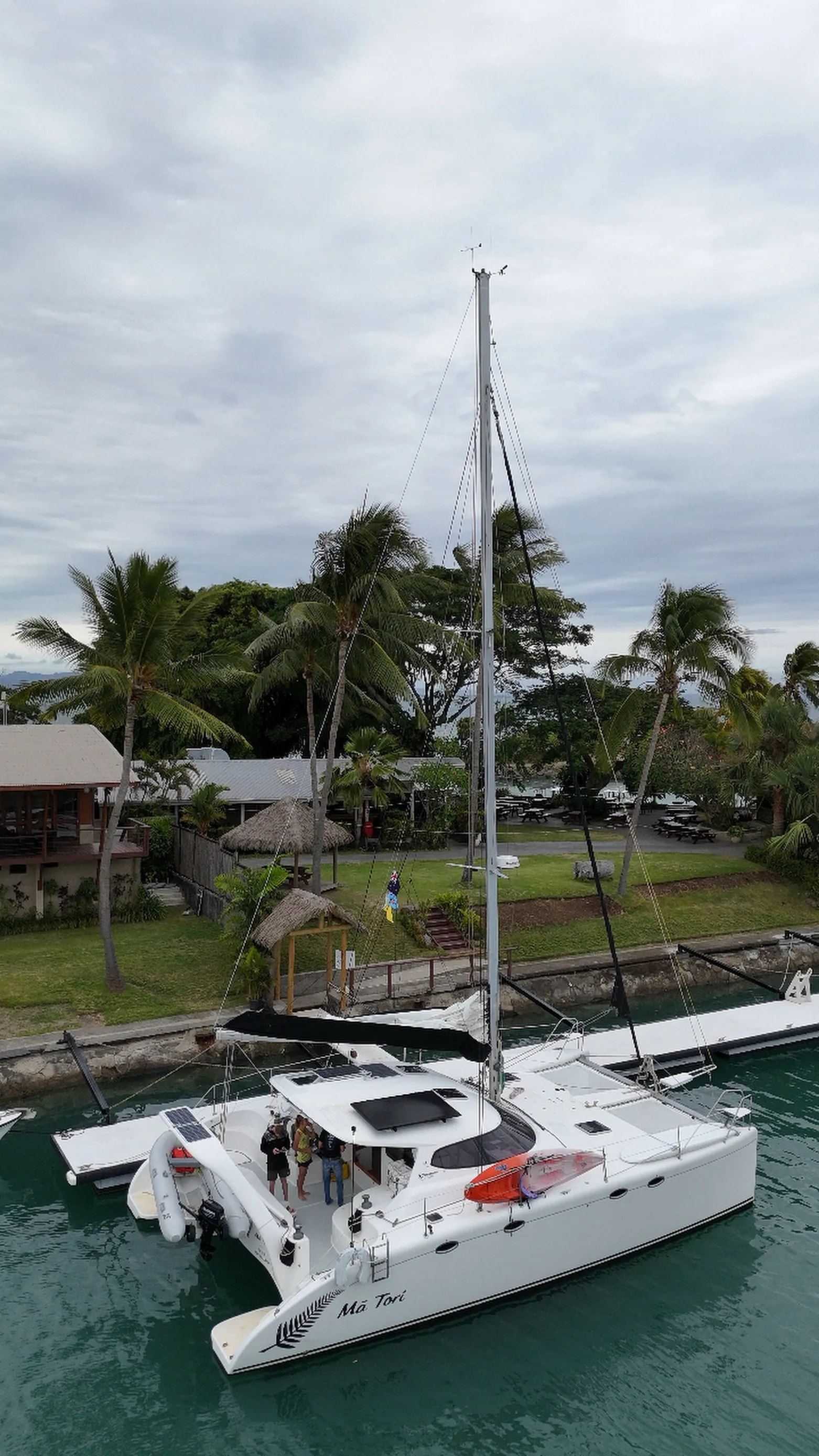
Keep reading: the thinking behind every date on this page is in why climatology is not a forecast; the run south itself is planned in timing the Fiji to New Zealand passage; and the whole season, month by month, is the subject of The Pacific Year. Or meet the boat that sailed it — Mā Tori, our Fusion 40 catamaran for sale.