
A monohull tells you when it's time to reef. She heels, she spills wind, she rounds up — the boat itself sounds the alarm. A cruising catamaran does no such thing. She stands upright and simply loads everything harder: rig, sails, rudders, autopilot, crew. The first real warning can be a windward hull going light, and by then you are well past the moment you should have acted.
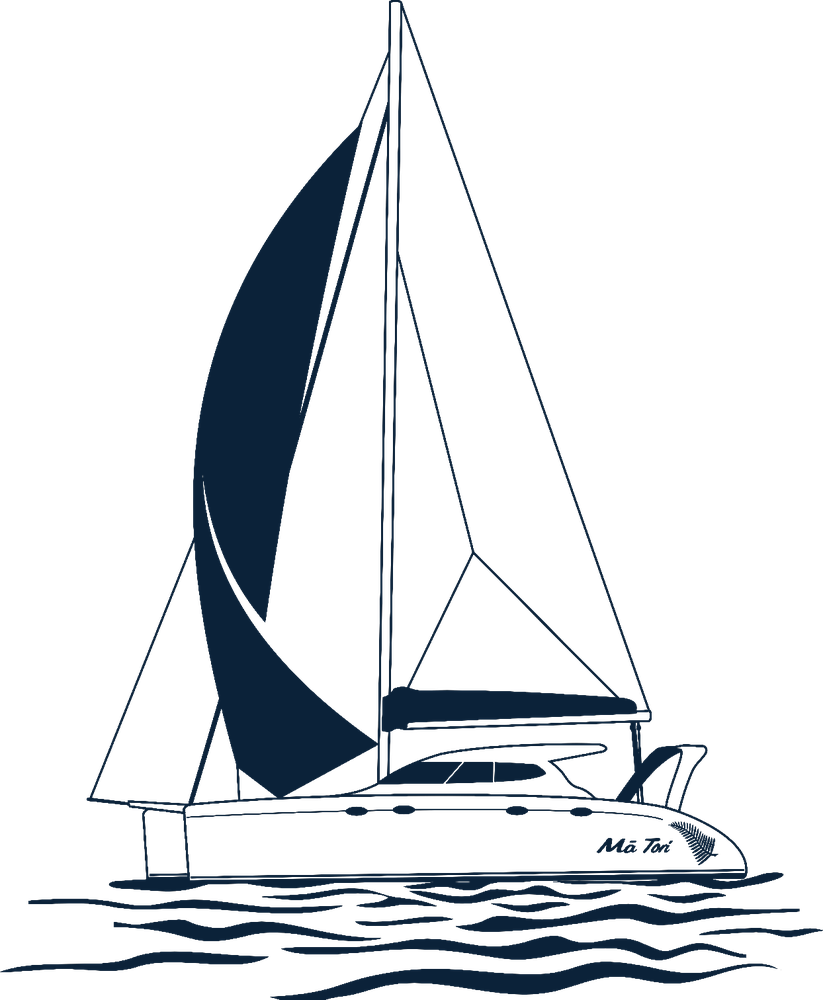
So on a cat you reef by the numbers instead of by feel. Below is the sail plan we work to aboard Mā Tori, our Fusion 40 — main, furling jib, code 0 and storm sail — set out as something you can drag rather than a table you have to decode. Grab the wind and watch what she should be carrying.
The reefing slider
Drag to your apparent wind — that's the number on the instruments, and what the sails actually feel.
worked out from your angle and speed
kn Set it to yours. With the wind angle on the dial below, it turns apparent wind into true.
Full main · full jib
Everyday sailing. Settled forecast, no squalls about.
- Mainsail
- Full main
- Headsail
- Full jib
- Code 0
- Getting busy — hand on the furling line
Tick anything that applies right now
The slider above answers how much sail. The next question is where to put it — because the same 20 knots is a different boat on the nose than it is on a broad reach. Set the wind angle below and she trims to suit.
The wind angle dial
Drag the wind around the boat, or use the arrow keys. She's carrying whatever the slider above says, seen from directly overhead. Pick the jib, the code 0, or both at once for a gull wing. Bring the wind aft and you choose how to run.
starboard tack
Beam reach
The cat's happiest angle and her fastest.
- Headsail
- Full jib
- Main trim
- Traveller to leeward, twist in the top
- Boom
- 36° off the centreline
- True wind
- about 16 kn
- Watch for
- Apparent wind building as she accelerates
Headsail
Jump to a point of sail
Wind's well aft. How do you want to run?
Tips for this wind and this angle
All the tips and tricks in one list
Disclaimer. These tools are a guide, not instructions. The numbers are baseline figures for a cruising catamaran of around 40 feet, not measured on your boat, and the true wind is worked out from what you enter. Your rig, sails, load, crew and the sea on the day all change the answer. The skipper makes the call, and we can't take responsibility for decisions made using these tools. Work to your sailmaker's and rigger's limits, and if in doubt, reef earlier.
The five rules that matter more than the table
- Reef for the gusts, not the average. If the average is 18 and the gusts are 27, you're a 27-knot boat. Set the sail plan for the top number.
- A cat gives you no warning. A monohull heels and spills wind — that's your alarm bell. Mā Tori just keeps standing up and loading everything harder until something lets go.
- If you're thinking about it, you're already late. Reefing is easy at 18 knots and horrible at 28.
- Reef before dark. Every time. Put in the reef you'd want if it built 8 knots overnight. Shaking one out at 2am is a five-minute job; putting one in at 2am is not.
- Reef before the squall, not during it. If it's black on the radar and building, sort the sail plan while it's still calm.
Mainsail
Apparent wind is the primary number — it's what the instruments show and what the sail feels. True wind is a rough guide for planning, and the true column assumes the wind on or aft of the beam. Hard on the wind the true figure is lower than the apparent, not higher. The slider works it out properly from your angle and boat speed. This assumes three reef points in the main.
| Set | Apparent | True (approx) | What it's for |
|---|---|---|---|
| Full main | 0 – 16 | 0 – 18 | Everyday sailing. Light to moderate, settled forecast, no squalls about. |
| Reef 1 | 16 – 22 | 18 – 25 | Fresh breeze. Also the default for any night watch and for a forecast that's building. |
| Reef 2 | 22 – 28 | 25 – 32 | Strong breeze. Sea is building. She'll still make good ground with this in. |
| Reef 3 | 28 – 35 | 32 – 40 | Near gale. Small, flat, hard-sheeted scrap of sail — enough to steer and stop her rolling. |
| Main down | 35+ | 40+ | Storm sail only, or bare poles. Survival mode — the goal is comfort and control, not miles. |
Headsail — the furling jib
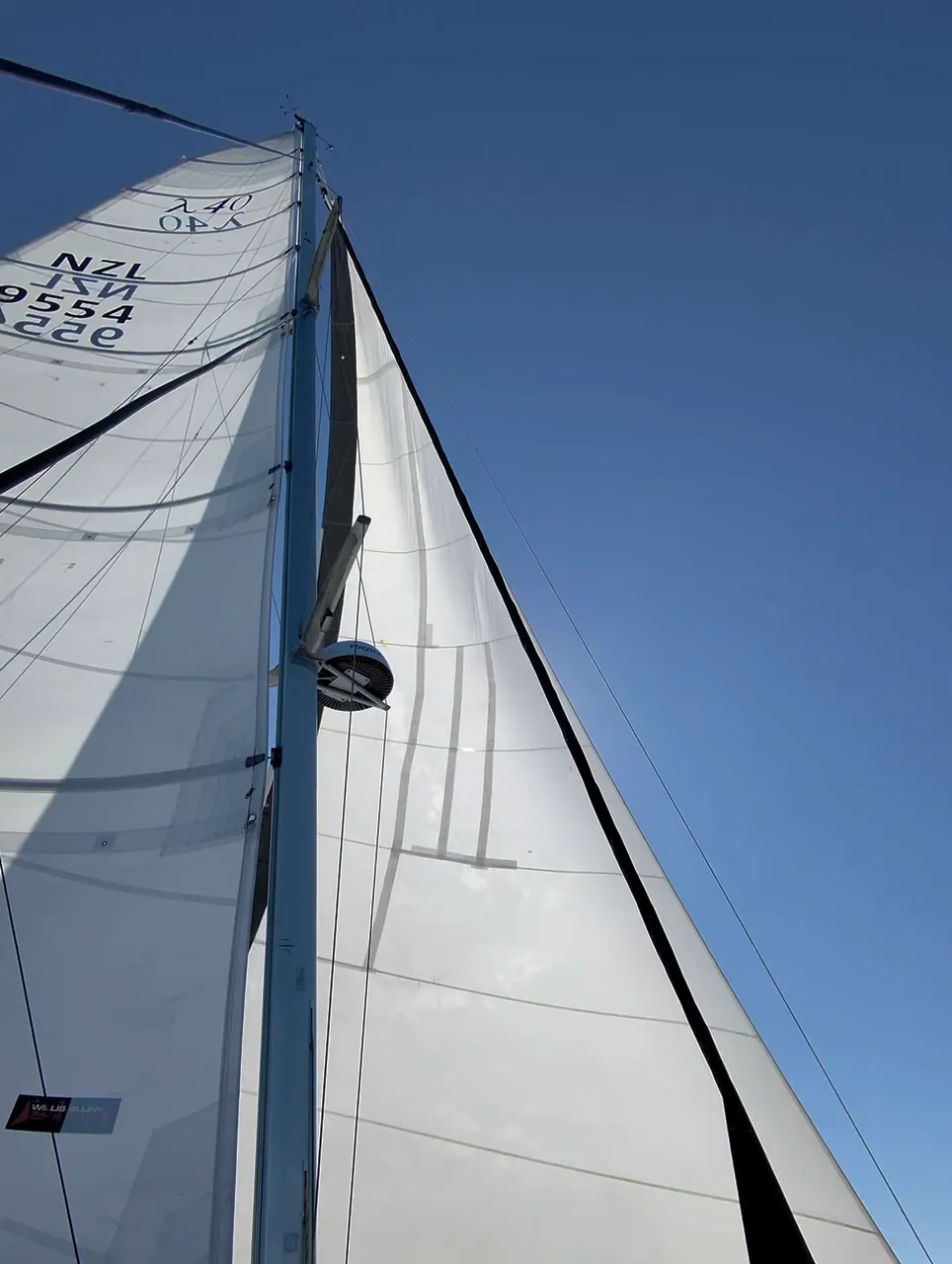
Roll the jib away in stages. Past about half furled it loses shape badly, so beyond that you're better off on the storm sail.
| Set | Apparent | True (approx) | What it's for |
|---|---|---|---|
| Full jib | 0 – 18 | 0 – 20 | Everyday. Pairs with full main or reef 1. |
| Roll to 75% | 18 – 24 | 20 – 27 | First step. Keeps her balanced against reef 1 or 2. |
| Roll to 50% | 24 – 30 | 27 – 34 | Strong breeze. Move the sheet car forward to keep the foot from bagging out. |
| Roll to 30% or away | 30 – 35 | 34 – 40 | Shape is gone by here. Furl it right off and swap to the storm sail. |
| Storm sail | 35+ | 40+ | Small, strong, low down. Set it before you need it, not after. |
Code 0
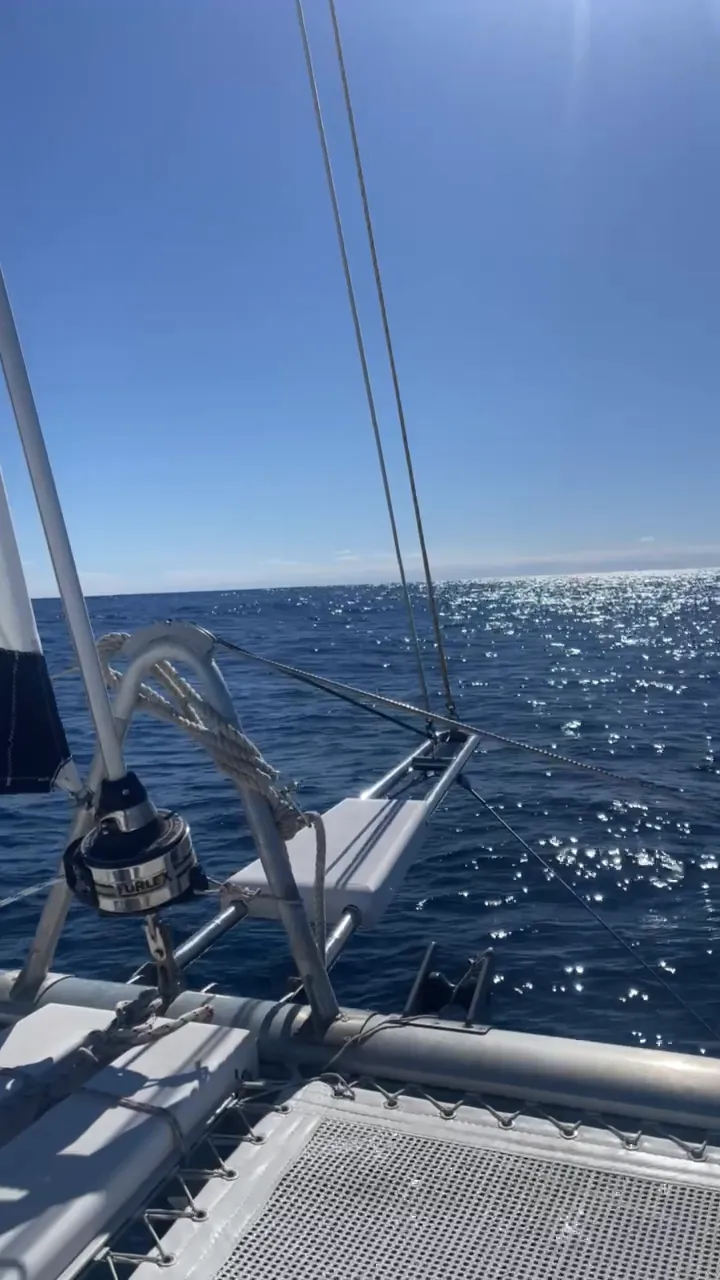
A light-air reaching sail, not a heavy-weather sail. It's the first thing that comes down when the breeze fills in.
| Set | Apparent | Angle | What it's for |
|---|---|---|---|
| Best range | 6 – 12 | 60° – 130° | Where it earns its keep. Turns a slow drift into real boat speed. |
| Getting busy | 12 – 15 | 70° – 120° | Still fine, but have someone on the furling line and start watching the sky. |
| Furl it | 15+ | — | Hard ceiling. Bear away to unload it first, then furl. Never try to furl it loaded up. |
Points of sail — what to fly at what angle
Angles are apparent, measured off the bow, and they work the same on either tack. The numbers a cruising cat cares about are the two ends: she stops sailing about 28° off the wind, and she stops sailing well somewhere past 150°.
| Angle | Point of sail | Front sail | Notes |
|---|---|---|---|
| 0° – 28° | No-go zone | Nothing will fill | She won't sail here. Bear away to 45° and foot, or start an engine. |
| 28° – 50° | Close-hauled | Full jib, sheeted hard | As high as a cruising cat usefully goes. Foot off a few degrees and she goes faster for almost no extra distance. |
| 50° – 75° | Close reach | Full jib, or code 0 if light | Fast, and far easier on boat and crew than beating. |
| 75° – 100° | Beam reach | Full jib, or code 0 below 15 kn | Her fastest angle — and where apparent wind builds hardest as she accelerates. Reef sooner than the number suggests. |
| 100° – 135° | Broad reach | Code 0 if the wind allows, else jib | The cruising angle. Get a preventer on. |
| 135° – 165° | Deep broad reach | Jib going soft — pole it out or heat up | The main starts stealing the headsail's wind. Slatting is chafe. |
| 165° – 180° | Dead run | Jib blanketed — goosewing it, or come up 25° | Slowest, rolliest, and the one with the accidental gybe in it. Gybe down in stages instead. |
Quick reference — what to fly together
Apparent wind again. Upwind you'll hit these numbers sooner and downwind later, because your own boat speed adds to or subtracts from the apparent.
| Apparent | Main | Front sail | Notes |
|---|---|---|---|
| Under 12 | Full | Code 0 (reaching) or full jib | Or the diesels earn their wages. |
| 12 – 16 | Full | Full jib | Code 0 comes down at 15. |
| 16 – 22 | Reef 1 | Full jib to 75% | The standard night-watch setup. |
| 22 – 28 | Reef 2 | 50 – 75% jib | Still fast. Still comfortable. |
| 28 – 35 | Reef 3 | 30 – 50% jib | Keep the sail plan low and balanced. |
| 35+ | Down | Storm sail | Ease off, get comfortable, ride it out. |
You've left it too late if…
- The windward hull is getting light or lifting clear. That is the last warning you get. Dump the traveller and reef now.
- You're burying the leeward bow when you press. Too much sail forward, or too much sail full stop.
- She won't bear away when you ask her to. Too much main, not enough headsail. Fix the balance before it fixes itself.
- The autopilot is working hard and wandering. It's telling you the boat is overpowered before you've noticed.
- You have to shout to be heard in the cockpit. Old rule, still works.
When to reef earlier than the table
Reef earlier than these numbers when you're loaded heavy, sailing short-handed, sailing at night, punching into a short steep sea, or there's a squall line coming through — that's exactly what the tick-boxes in the slider above are doing. Reef later only when the sea is flat, it's daylight, and you've got hands on deck.
One note on rig configuration: all of this assumes three reef points in the mainsail. If your main only has two, use the reef 2 numbers as your reef 2 and drop the main at around 30 knots apparent instead of 35.
Read this bit before you use these numbers
These are baseline figures for a cruising catamaran of Mā Tori's size and weight — not measured, instrumented figures from this specific boat. They're a sound starting point and they're the framework we work to, but no published table beats the numbers a skipper has arrived at over thousands of miles in their own boat.
Treat this page as a framework to mark up rather than gospel to follow. Every cat has her own manners: displacement, sail wardrobe, rig age, how she's loaded and how she's handled all shift these thresholds. If in doubt, reef earlier — nobody has ever regretted being one reef down.
Keep reading: the rig and sail handling get the full treatment in our Fusion 40 review, the practical side of a purchase is in buying a catamaran in New Zealand, and for the weather-routing half of offshore life see Starlink's new rules for cruisers. Or meet the boat herself — Mā Tori, our Fusion 40 catamaran for sale.