
The PredictWind DataHub is a US$299 box that takes the boat's NMEA 2000 position and wind, pushes it to a PredictWind tracking page over whatever internet the boat has, stores the track when the connection drops, and shares the instrument data over its own wifi. On the maker's numbers it is a tracker and a data logger first and a router second, and the features that make it more than that (over the horizon AIS, AI polars) need the US$499 a year Professional plan on top. We have not tested it. Mā Tori's track and Captain's Log run on PredictWind tracking, but the listing does not say what feeds the tracker, so this is a specification review.
What it is
The PredictWind DataHub is a small box, about 120 mm by 100 mm by 35 mm (PredictWind's own pages give two slightly different sizes) and 175 g, running on 9 to 60 V DC with reverse polarity protection. It has a USB port for tethering a phone, an ethernet WAN port, an ethernet LAN port, two wifi radios (one to join the boat's internet source, one to broadcast to your devices) and an NMEA 2000 interface. It draws 0.35 A at 12 V, 4.2 W, and nothing from the N2K bus. It has its own GPS, though PredictWind recommends the boat's GPS over NMEA 2000, and an SD card that logs the full N2K stream.
The protection is a conformal coating on the board, which PredictWind lists as "IP01". That is not a real IP rating. Read it as "mount it somewhere dry", a nav station locker, not a cockpit.
What PredictWind claims
From the product page and the help centre on 4 November 2026:
- GPS tracking. A position every 15 minutes (or hourly) to a tracking page, with wind speed and direction attached when N2K is connected. When the internet drops, reports are stored and uploaded when it comes back, so the track has no holes.
- Any internet source. Starlink by ethernet or wifi, an Iridium GO or GO exec, a 4G or 5G router, a phone hotspot, marina wifi. Not a Garmin inReach or an Iridium handset.
- Low data. Under 5 MB a month for hourly tracking, about 20 MB a month at 15 minutes with AI polars on, about 25 percent more with engine, temperature or battery data on the bus.
- Data sharing. N2K data, including AIS targets, rebroadcast over the DataHub's wifi and LAN port to Navionics, AquaMap, OpenCPN and the like.
- Over the Horizon AIS. AIS targets reported over the internet rather than heard over VHF, which PredictWind says extends your AIS picture "up to 300 nautical miles". Needs a Professional forecast plan.
- AI polars. A polar for your boat built from the real wind and speed data, for better routing. Needs a Professional plan and an N2K network that outputs true wind, COG and SOG.
- Anchor Alert, PredictMail, PredictWind Mode. An anchor alarm app that reads the N2K data, a compressed email service (US$59.95 for three months), and a Starlink data mode that blocks background apps from eating the allowance.
- Privacy defaults. GPS Tracking is the only service on out of the box, and PredictWind says it does not monetise position data.
The subscription sits underneath all of this. A tracking page comes with every PredictWind forecast plan, including Free. Standard, US$249 a year, is the first tier with weather routing and departure planning. Professional, US$499 a year, is the one the DataHub's clever features need. So a DataHub doing everything on the box costs US$299 plus US$499 a year, and a DataHub doing tracking alone costs US$299 and nothing.
What the independent reviews say
There are not many. Most of what turns up for "DataHub review" is PredictWind's own press release republished by the sailing news sites, and the Sail-World series with Sailing Zingaro reads as promotional, so we left it out. Three sources are worth your time.
Yacht magazine in Germany looked at the over the horizon AIS in February 2025. Their example is the one that sells it: a yacht at 10 knots meeting a container ship at 25 knots gets 8.5 minutes of warning from ordinary AIS and 8.5 hours from the internet-fed version. The caveats: it does not work over an Iridium GO, so the boats that most need a long AIS horizon mid-ocean cannot use it without Starlink. Near the coast the value is limited because shipping lanes bend. The polar data is theoretical. And with the Professional plan and a Starlink plan added, the running cost is real and so is the power draw of staying connected. Their verdict: worth it offshore and for racing, "not useful for all sailors".
Panbo's launch coverage ran the announcement in March 2022, and Ben Ellison's note under it is the honest summary: a "reasonably priced marine WiFi router" that also does tracking, and some boats will not need it. One reader asked how a box with no external antennas shares a 150 Mbps Starlink feed; another had an Iridium GO and an inReach already and could not see the gap. PredictWind's reply is the useful bit: a GO and a DataHub can sit on the same account, so you suspend the Iridium airtime in coastal waters and let the DataHub log offshore.
RV Mobile Internet, who review routers for a living, listed it at US$299 in 2022 and did not test it. Their spec sheet is still the clearest independent statement of what the standard box is as a router: Wi-Fi 5, 2.4 and 5 GHz at once, internal antenna only, no cellular modem, one LAN and one WAN port, not outdoor rated.
What we would check before buying
- What the tracker is for. If the only job is a position on a page for family and the insurer, the free PredictWind Tracker app on a phone over the Starlink wifi does it. PredictWind says the DataHub position is more accurate, and a phone goes flat or walks off the boat. Decide if that is worth US$299.
- Which GPS feeds it. PredictWind recommends the boat's N2K position, which means an N2K network and the M12 cable pack, sold separately. A Raymarine SeaTalkNG backbone needs Raymarine's adapter cable as well.
- Which plan you will keep paying for. Tracking: Free. Routing and departure planning: Standard, US$249 a year. Over the horizon AIS and AI polars: Professional, US$499 a year. Be honest about year three.
- The second connection. With Starlink as the only feed the DataHub stores the track through a dropout and uploads later, which is fine. An Iridium GO as the backup, it can use; an inReach it cannot.
- What it is not. Not a satellite device, not a plotter, not an AIS transponder, and not a reason to skip a proper second messaging system that shares nothing with Starlink.
Fit on a cruising cat like a Fusion 40
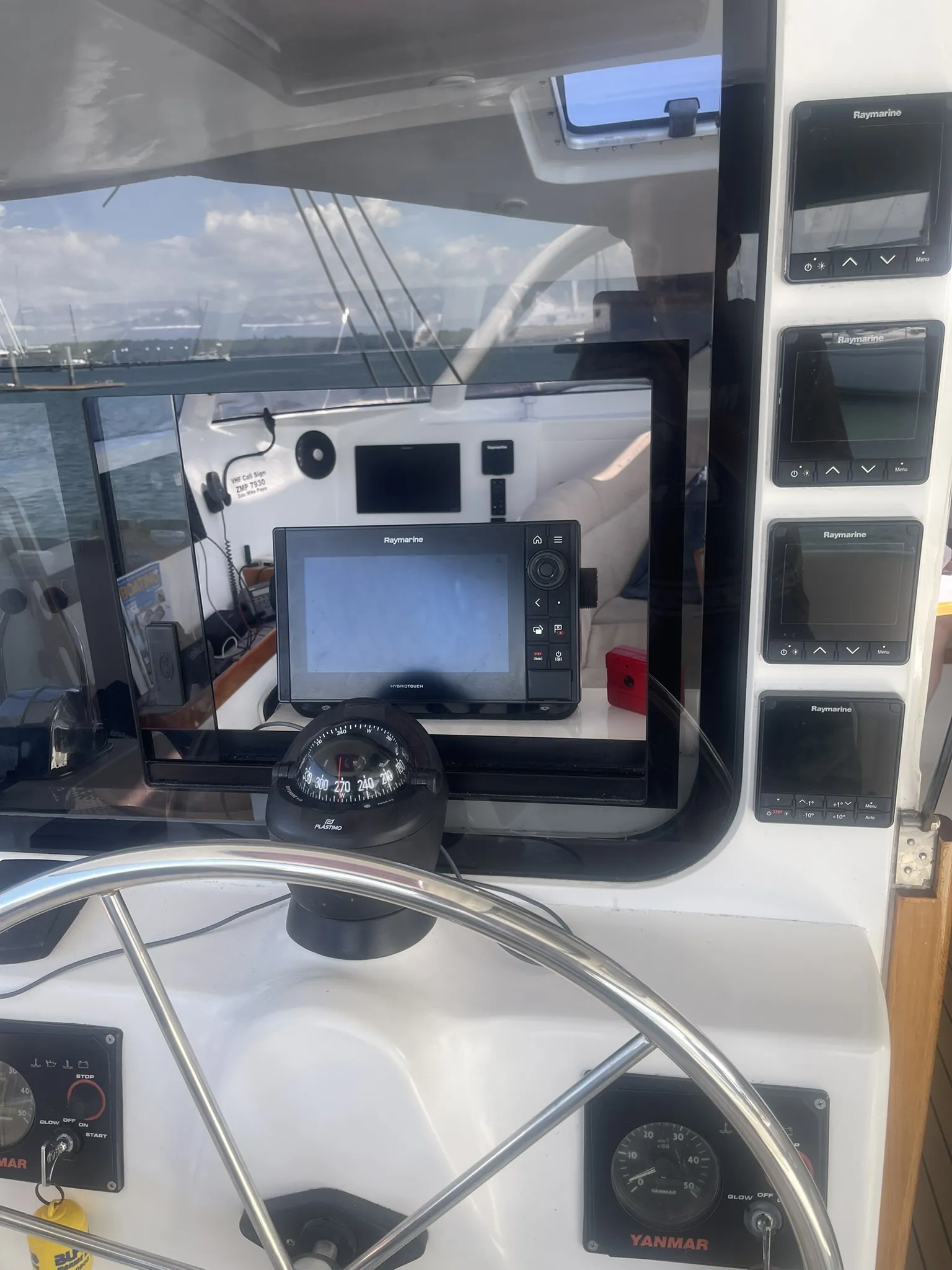
Power is not a question. 4.2 W is under 9 Ah a day on a 12 V boat, which a 700 W solar array does not notice, and it runs off a 24 V house bank too. The N2K side is the question. A 2007 boat with a Raymarine helm may have a SeaTalkNG backbone rather than a plain N2K one, and the adapter cable goes on the shopping list. Ethernet from the Starlink router to the WAN port is the setup PredictWind says just works; the wifi route and the fixes are in how to connect PredictWind to Starlink.
The AIS rebroadcast is handy on a cat: the helm, the nav station and a tablet in the cockpit all want the same targets, and the DataHub puts them on the wifi. The anchor alarm app does the same job from the bunk.
Where a forecast is still a forecast. The DataHub feeds PredictWind's routing a better polar, and better routing is still a model run through your boat's numbers. It does not change what the models know. For the passage that matters to our readers, the Fiji to New Zealand run in October and November, the routing's job is to pick the departure day, and the weather after day four is a guess whoever draws the line. Read why climatology is not a forecast before you trust a routing arrow, and the Fiji to New Zealand passage guide for what the windows have looked like.
Alternatives
PredictWind Tracker app. Free, phone GPS over the boat's wifi, less accurate, no N2K data, no offline logging. The right answer for a season of coastal cruising with Starlink.
Iridium GO or GO exec. A satellite device, so it does the one thing the DataHub cannot: get a position and a GRIB out when the Starlink is down. The DataHub plugs into either, and the GO's basic airtime plan has enough messages for hourly tracking on its own.
Garmin inReach Messenger Plus. Tracking and messaging over Iridium with its own battery, no N2K, no wifi, and it will not talk to the DataHub. Our inReach Messenger Plus review covers where it sits as the second system.
DataHub Pro. US$599 for a 128 GB SSD, Wi-Fi 6 to 200 Mbps against the standard box's 70 Mbps, an LTE modem with a T-Mobile SIM, and the MOB Watch app. The SIM is coastal, and for the South Pacific that is not the reason to spend the extra US$300. If the Starlink bill is the worry, the Starlink Personal Maritime plan guide is where the real money is.
Price and where to buy
US$299 for the DataHub and US$599 for the DataHub Pro at PredictWind's own shop on 4 November 2026. The NMEA 2000 M12 cable pack is extra. PredictWind ships from the USA, Germany, Australia and New Zealand, which matters for GST and duty: order from the NZ or AU warehouse if that is where the boat is. There is no affiliate link on this page; if that changes it will say so at the top.
Prices and plans move. Check the maker's pages before you order.
Questions people ask about the PredictWind DataHub
Does the PredictWind DataHub need a subscription?
Not for tracking. A tracking page comes with every forecast plan including Free. Over the horizon AIS and AI polars need Professional at US$499 a year, and weather routing needs Standard at US$249 a year.
Does the DataHub work with Starlink?
Yes. Ethernet from the Starlink router into the DataHub's WAN port is the simplest way, or it joins the Starlink wifi. It stores position reports every 15 minutes through a dropout and uploads them when Starlink comes back.
Does the DataHub work with an Iridium GO or a Garmin inReach?
An Iridium GO or GO exec, yes, and both can sit on the same account as the DataHub. A Garmin inReach, no. Over the horizon AIS does not work over the GO at all.
DataHub or DataHub Pro?
The standard DataHub for a cruising boat in the Pacific. The Pro's LTE SIM, faster wifi and SSD are coastal, US-leaning advantages at twice the price.
Keep reading: wire it up with the PredictWind and Starlink setup guide, follow Mā Tori's live track, see what the crew passages involve, or look over a bluewater catamaran for sale with the tracker already running.