
The Garmin inReach Messenger Plus is the inReach that sends photos and 30 second voice messages over Iridium, and on a cruising cat with Starlink its job is to be the system that shares nothing with the dish. On the published numbers and in three independent reviews it does that job well, at AUD 899 plus a plan from AUD 13.50 a month. It is not an EPIRB and does not stand in for one. We have not tested it. Mā Tori carries Starlink and Iridium and no HF, so this is the review we would have wanted first.
What it is
A palm sized satellite communicator, 117.2 grams and 7.8 by 6.4 by 2.3 centimetres on Garmin's Australian product page, with a small monochrome screen, three buttons, a guarded SOS button, USB-C and an IPX7 water rating. It talks to the Iridium network, which Garmin calls 100 per cent global, and pairs with a phone over Bluetooth to the Garmin Messenger app. On the device alone you can send and receive texts of up to 1,600 characters, trigger an SOS to Garmin Response, Garmin's 24 hour coordination centre, and share your position. With the phone paired you get group messaging, weather requests, photos, voice messages, live tracking and off-grid navigation. It launched in September 2024 at USD 499.99, per the Garmin announcement on Panbo. The original inReach Messenger, without photos or voice, is still sold at AUD 499.00.
What Garmin claims
From Garmin's spec sheet, the only place these numbers come from until someone measures them:
- Battery: up to 600 hours with a location every 10 minutes in low power messaging mode, up to 110 hours in performance mode, up to 120 and 70 hours at a 2 minute interval. Up to 250 photo or voice messages on one charge. Up to a year powered off. All with a full view of the sky, per the note under the table.
- Messaging: text up to 1,600 characters, photos, voice up to 30 seconds, over the phone's data when there is any and satellite when there is none.
- Plan: an active subscription is required for everything, SOS included.
What the independent reviews found
Three hands-on reviews are worth your time. None are sailors, so add the boat yourself.
GearLab's inReach Messenger Plus review by Jediah Porter, November 2024, scored it 86 out of 100, first of 14 satellite communicators tested. SOS messaging got 10 out of 10. Ease of use got 6, because the on-device interface is basic and almost everyone will drive it from the phone. The point we noted: photos and voice work between Garmin Messenger app users, and a rescue dispatcher is unlikely to use either, so in an emergency the media goes to a contact ashore who relays it. The larger antenna put up with being buried in a pack better than the smaller inReach units.
Cris Hazzard's review on HikingGuy, June 2025 and updated August 2026, has the measurements. Texts went in under 2 minutes in most conditions. Photos took 10 minutes or longer in dense forest and 1 to 2 minutes with open sky. In performance mode under heavy tree cover, sending photos, the battery lasted about 22 hours. In low power mode with open sky it barely moved in 5 hours. The Plus is about 20 to 30 per cent faster than the original Messenger, which he says is only worth the extra money if you want the photos and voice.
Recoil Offgrid's review by Patrick Diedrich, November 2024, is the user's view. Typing on the device is slow enough that he pre-writes messages. No lanyard in the box. He rates the interactive SOS, texting with the coordination centre rather than firing a one-way beacon, as the reason to own one over a PLB.
What it adds to a Starlink boat
Not much bandwidth and a lot of independence. Starlink is one dish, one power feed, one account and one company's plan rules, and we have written three posts on what happens when the rules move: the Starlink changes for cruising sailors, the 30 day rule workarounds and the Personal Maritime plan. The Golden Globe lessons post made the case that the second system should share nothing with the first: different hardware, different power, different account. A Messenger Plus on its own battery, a different constellation and a plan paid to a different company is exactly that.
When the dish is down it gives you a weather request, a text to the boat you are buddy sailing with, a position report home on Garmin's share page (ours goes out on the tracking page through PredictWind, a separate path), and Garmin Response if things go wrong. What the Plus adds is the photo and the voice note: a picture of the broken part to the rigger in Whangarei, or 30 seconds of your own voice to family. Nice to have. The other end has to be on the Garmin Messenger app, and each one costs a media message off the plan.
Where it stops short of an EPIRB
This is the bit that matters. The inReach SOS goes over Iridium to Garmin Response, a private coordination centre that then brings in the rescue authority. An EPIRB transmits on 406 MHz through the search and rescue satellite system straight to the rescue coordination centre, with no subscription and no account that can lapse. AMSA's beacon types page says that in most states an EPIRB is required on boats travelling more than 2 nautical miles from the coast, that a PLB is not accepted as a substitute for an EPIRB under state marine carriage rules, and that an EPIRB has to run for a minimum of 48 hours against 24 for a PLB. A satellite messenger is not on that page. The NZ departure guidance in our NZ Cat 1 inspection checklist accepts a satellite messenger with a current subscription as the long range comms option, on top of the EPIRB and the per person beacons, not instead of them.
So the order on a cruising cat is the registered 406 EPIRB first, a PLB or AIS beacon per person second (the beacons are in the man overboard system post), then the inReach as the thing you use every day and in the hours after the EPIRB has gone off, when texting "two aboard, one hull flooded, raft ready" is worth a lot. They fail differently, which is the whole idea.
What we would check before buying
- Whether your contacts will run the Garmin Messenger app. If not, the AUD 400 over the original Messenger buys photos and voice that go nowhere.
- The plan. On Garmin Australia's inReach consumer plans page on 21 October 2026: Enabled is AUD 13.50 a month with every text at 0.85 and every photo or voice message at 1.70, Essential is 25.00 with 50 texts and 25 media messages, Standard is 50.00 with 150 texts, 50 media messages and unlimited 10 minute tracking, Premium is 85.00 with everything unlimited and 2 minute tracking. Activation is AUD 70 and service can be suspended for up to 12 months. For a passage boat that wants a 10 minute track and two weather requests a day, Standard is the one to price.
- Sky view at the mount. Garmin's battery figures assume a full view of the sky, and a cockpit under a hardtop with a solar array is not that. The HikingGuy canopy result, 22 hours, is a fair stand-in for a bad mount.
- Who answers. Garmin Response is in the loop on every SOS. Read how the handover to RCCNZ or AMSA works before you need it.
Fit on a Fusion 40
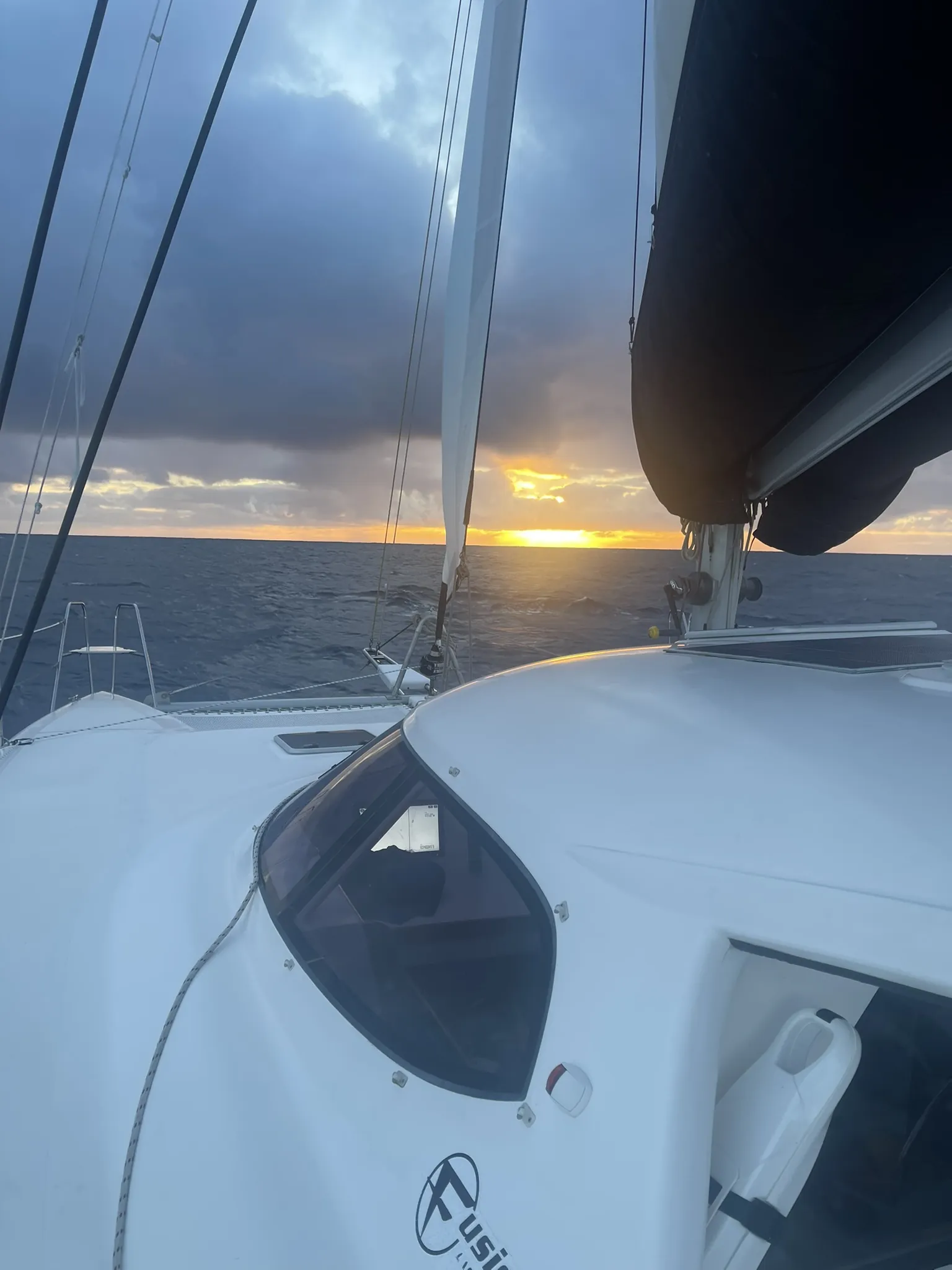
Easy. No install: a USB-C lead off the house bank, a spot with sky above it, a lanyard you buy yourself. On Mā Tori that is the nav station shelf on passage and the grab bag when it matters, where the whale strike post already puts the sat comms. Its tracking runs through Garmin's own share page, separate from the PredictWind track in connecting PredictWind to Starlink, so the two tracks do not share a failure. On the 1,100 nautical mile Fiji to New Zealand passage, a 10 minute track and two weather requests a day fit inside a Standard plan with room to spare.
Alternatives
- Garmin inReach Messenger (original). AUD 499.00 on Garmin Australia's page. Same size, no photos or voice, 160 character messages. GearLab calls it a Best Buy, and if your contacts are on SMS it does the same job for AUD 400 less.
- Iridium GO or a satellite phone. More money and more power, but a voice call rather than a voice note, and GRIBs without an app at the other end.
- Starlink Mini on a battery. Not a second system in our sense, same account and same constellation, but the grab bag option a lot of boats are moving to. The Offshore Starlink Playbook has the power numbers.
Price and where to buy
AUD 899.00 on Garmin Australia's product page on 21 October 2026, shipping in 1 to 3 days. Garmin New Zealand sells the same unit. We have no affiliate arrangement with Garmin and earn nothing here. The plan is activated in the Garmin Messenger app after the box arrives.
What we don't know
- How it behaves on a moving boat under a hardtop and solar. Every published test is on foot.
- Whether the photos are sharp enough for a rigger or a mechanic to diagnose from. Nobody has published a sample at the compressed size.
Prices, plans and safety rules change. Check Garmin's page, AMSA or Maritime NZ and your flag state before you rely on anything here.
Questions people ask about the inReach Messenger Plus
Is the Garmin inReach Messenger Plus an EPIRB?
No. Its SOS goes over Iridium to Garmin Response, a private coordination centre. An EPIRB transmits on 406 MHz straight to the rescue coordination centre, needs no subscription and is what most Australian states require beyond 2 nautical miles. The inReach sits next to the EPIRB, not in place of it.
Can photos and voice messages go to any phone?
Photos and 30 second voice messages go between users of the Garmin Messenger app. A contact on ordinary SMS gets text only. Garmin Response can receive photos and voice during an SOS. They count against the plan: 25 a month on Essential, 50 on Standard, unlimited on Premium, and AUD 1.70 each on Enabled or over the allowance.
What does the inReach Messenger Plus cost in Australia?
AUD 899.00 on Garmin Australia's page on 21 October 2026. Plans on the same date are AUD 13.50 a month for Enabled, 25.00 for Essential, 50.00 for Standard and 85.00 for Premium, plus a 70.00 activation fee. Prices change, so check the Garmin page before you buy.
How long does the battery last?
Garmin says up to 600 hours in low power messaging mode with a location every 10 minutes, up to 110 hours in performance mode, up to 250 photo or voice messages on a charge, and up to a year switched off, all with a full view of the sky. One independent tester got about 22 hours in performance mode under heavy tree cover while sending photos, which is the number to plan around under a hardtop.
Keep reading: the safety and survey checklists are in the Catamaran Buyer's Pack, and our bluewater catamaran for sale comes with Starlink and Iridium already aboard.