
Everyone knows the ratio. Five to one, seven to one, ten if it's blowing. What almost nobody does at the bow, with the sun going down and a beer waiting, is the arithmetic that turns the ratio into metres — from the roller, at high water, and then the second sum, the one that tells you how big a circle you have just claimed in a crowded anchorage.
So here it is as something to drag. Set the depth, the tide still to come, the height of your bow roller and how hard it is blowing, and it tells you how much chain to lay and how far you will swing — then draws both, because the picture is usually the surprise. Then add a neighbour or two, shift the wind, and see who you meet at three in the morning.
The anchor scope calculator
Depth is what the sounder says now; the tide slider adds what is still to come. Scope is measured from the bow roller, because that is where the chain is.
Side view — the chain's sag is what absorbs the gusts. Straight chain is chain that has run out of ideas.
Top view — the circle you have just claimed. Add a neighbour and shift the wind.
- Depth from roller
- Anchor to bow
- Swing radius
- Swing circle
The sum, so you can do it without the slider
Depth is the sounder reading, plus the tide still to rise, plus the height of your bow roller above the water. Multiply that by the ratio and you have the rode to lay. On a Fusion 40 in six metres with a metre and a half of tide to come, 5:1 overnight is not 30 m of chain — it is 44 m, and half the anchorage is lying to 30.
Swing is the second sum. The horizontal distance from anchor to bow is close to the rode length in shallow water and noticeably less in deep water — the calculator uses the straight-line figure, which slightly over-states it, and that is the safe direction to be wrong in. Add your boat's length and you have the swing radius. Double it for the circle. If another boat's circle overlaps yours and you are lying to different rode lengths or one of you is on rope, you will meet at three in the morning when the tide turns — which is exactly what the neighbour button is for.
Five things the ratio doesn't tell you
- Scope is not holding. Ten to one on an anchor that never set is ten to one of nothing. Back down on it, hard, in gear, and watch a transit on the shore until it has stopped moving. Then set the alarm anyway.
- Measure from the roller. Two metres of bow height on a catamaran is a third of the depth in six metres of water. Skipping it is the most common way to lay 4:1 while believing it is 5:1.
- Use a snubber, every time. All-chain rode has no stretch. Without a snubber the shock loads go straight into the windlass and the deck it is bolted to, and the noise alone will keep the off-watch awake.
- More scope is free until it isn't. Long rode in a crowded anchorage is a bigger circle. If the calculator says you can't fit, the answer is another spot, not less chain.
- Rope changes the picture. A chain-and-rope rode has less catenary to absorb gusts, so it wants more scope — the calculator adds two to the ratio — and it chafes, at the roller and on anything on the bottom. Coral and rope are a poor pairing.
Read this bit before you trust it with your boat
The ratios are the conventional rules of thumb for an all-chain rode — the same ones in every seamanship book — and the geometry is simple trigonometry. The gust and the neighbours are cartoons: they show what the numbers mean, not what your anchor will do. Holding is a property of the anchor, the seabed and the set; scope only gives the anchor a chance to do its job.
Use the numbers as a starting point to mark up with your own experience of your own boat. If in doubt, lay more, and if there is no room to lay more, go somewhere there is.
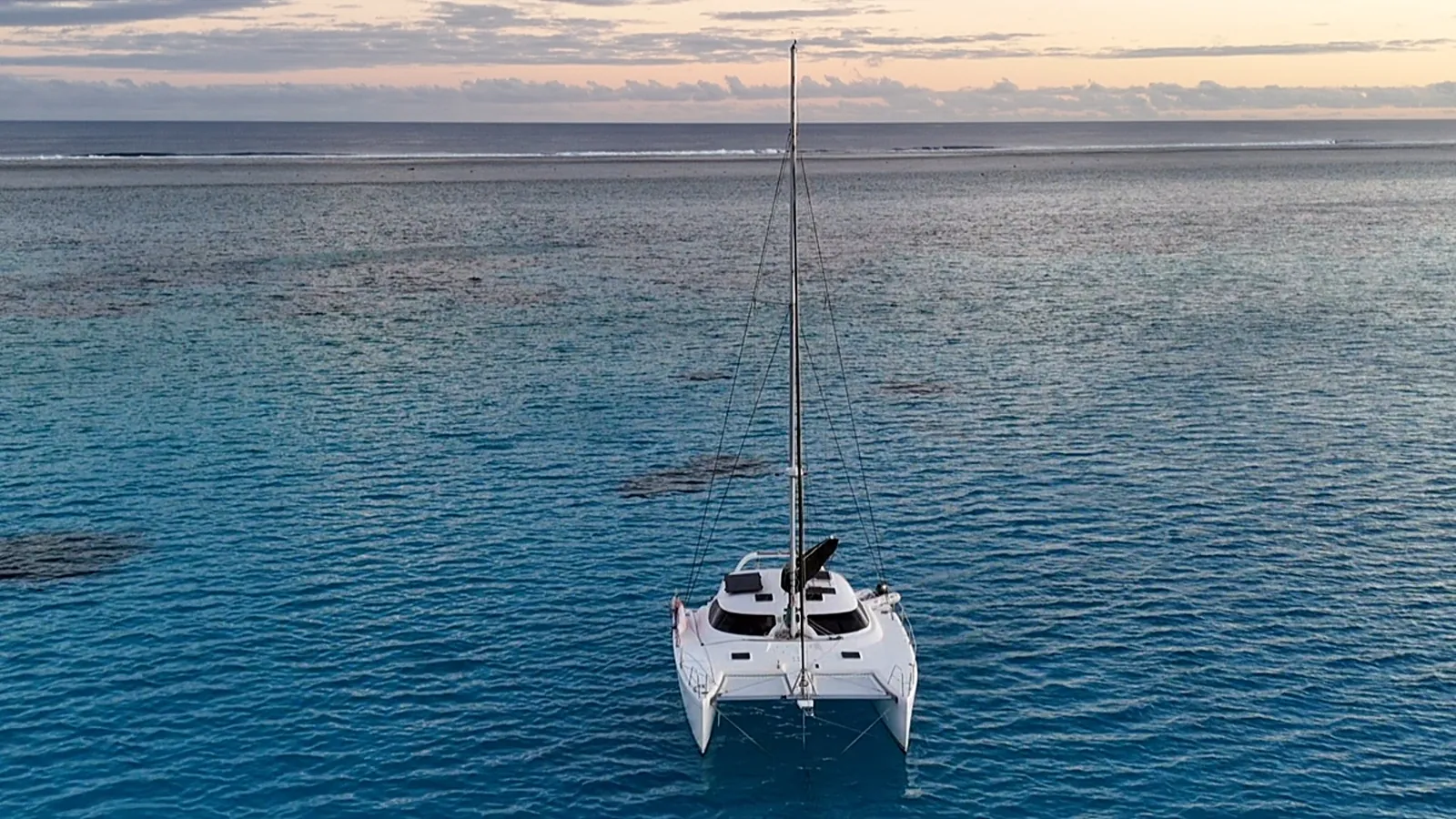
Keep reading: the ground tackle and what to check on it are part of the survey walkthrough in the Catamaran Buyer's Pack; where you will actually be anchoring, and when, is the subject of the South Pacific cyclone-season plan; for what to do when the anchor is up, there is the reefing slider; and why the season matters more than the forecast is in climatology is not a forecast. Or meet the boat herself — Mā Tori, our Fusion 40 catamaran for sale.