
Our previous post covered what changed in Starlink's August 2026 rules — Global Roam discontinued, Roam Unlimited capped at 30 days outside your registered country, and Priority pricing for anything beyond. This post is the practical half: the legitimate ways cruisers are working within the new rules, with the maths done for the New Zealand–Fiji–Tonga–Vanuatu circuit we actually sail. Nothing here involves breaking Starlink's terms of service — these are all levers the system itself provides. It just no longer provides them by default.
Prices and policies below are accurate as at late August 2026 and quoted in USD unless noted. Starlink adjusts both frequently and per-country — verify against your account before acting.
First, know your levers
Under the new rules you have exactly four: where your account is registered (your "home" country, which is where unlimited Roam data lives), the 30-day visit clock (which resets each time you return home), plan switching (Roam to Global Priority and back, month by month), and account localisation (moving your registration to the country you're actually in). Every workable strategy is a combination of these four.
Lever 1: register the account where you actually cruise
The single biggest decision is which country your account calls home. A boat cruising the South Pacific with an account registered in the US or Australia starts every island season on the 30-day clock. The same boat with its account registered in Fiji has unlimited Roam data through the heart of the season — Fiji being where most NZ and Australian boats spend the bulk of their tropical winter — and only starts the clock when it sails on to Tonga or Vanuatu.
Better still, Pacific-registered plans are among the cheapest in the network. Cruisers comparing service addresses report Roam Unlimited pricing (converted to USD) of roughly $95 in Vanuatu, $100 in Tonga and similar in Fiji and Samoa — comparable to or cheaper than the same plan registered in NZ, Australia or the US. You'll need a service address in-country; cruisers commonly use a marina. Denarau and Vuda in Fiji are used to the request.
The catch: your unlimited data now lives in the islands, so the equation flips when you sail home — your NZ or Australian summer becomes the "abroad" period on a 30-day clock. Which is why this lever pairs with the next one.
Lever 2: sequence the season around the clock
The 30-day limit is per visit, not per year. Sequenced deliberately, a classic Pacific season fits inside the rules better than the headlines suggest. Two worked examples:
| Season plan | Account home | How the clock runs | Weak point |
|---|---|---|---|
| NZ boat, single-country season (NZ → Fiji → NZ) | New Zealand | Fiji visit exceeds 30 days — expect one or more Priority months or a mid-season fix | Any Fiji stay over 30 days |
| NZ boat, island-registered (account moved to Fiji) | Fiji | Unlimited all season in Fiji; NZ summer runs a 30-day clock, then localise back or ride Priority | The NZ summer months |
| Multi-country season (Fiji → Tonga → Vanuatu) | Fiji | Unlimited in Fiji; Tonga and Vanuatu are separate 30-day visits — fine if you keep each leg under a month and touch back through Fiji | Lingering 30+ days in Tonga or Vanuatu |
Note the pattern in row three: because the clock is per-visit and resets in your home country, a Fiji-registered boat that does five weeks in Tonga has a problem, but one that does four weeks in Tonga, a week back in Fijian waters, then four weeks in Vanuatu doesn't. The South Pacific got no regional grouping (unlike Europe or US/Canada), so the geography of your season now matters in a way it didn't in 2025. For many boats it changes nothing except awareness; for slow wanderers it's a genuine constraint.
Lever 3: buy Priority months only when you need them
Global Priority at $250 for 50GB reads as outrageous next to the old Roam pricing — as a permanent plan. As an occasional plan it's more defensible. Starlink lets you change plans, so the cost-effective pattern is: run Roam Unlimited inside its rules, and switch to Global Priority only for the specific month your plans break them — the long Tonga stay, the ocean passage, the leg where the 30 days simply won't stretch. One or two Priority months a season adds $150–$400 over the old world's costs. Annoying; not cruise-ending.
Two things to know before you lean on it. First, Priority data is metered — 50GB disappears fast if the crew streams video, so a Priority month is a "weather, work and WhatsApp" month, not a Netflix month (after the block, you're throttled to about 1 Mbps, which still handles weather and messaging). Second, Global Priority is also the plan that's cleanly authorised for ocean use — so for a multi-day offshore passage like NZ–Fiji, a Priority month doubles as the passage-legal option, then you drop back to Roam at the other end.
Avoid the trap of Local Priority: it's cheap ($55 for 50GB) but designated inland — not for coastal or ocean use — and the word from industry watchers is that the water restriction is likely to be enforced more strictly than the old rules ever were. It's a plan for land bases, not boats.
Lever 4: localisation — the full account move
Localisation means re-registering your account in a new country: a proper shutdown of the old account, a new sign-up with an in-country service address, and antenna re-verification. Cruisers who've done it describe it as time-consuming but doable, and there are waiting periods between successive moves — so it's a lever you pull once or twice a year at natural turning points (arriving in Fiji for the season; returning to NZ for cyclone season), not something you can hop between islands with. Plan the move for somewhere with good shore internet and a few days at anchor, keep a Priority month or the backups below as cover for the gap, and treat the marina-address arrangement as something you organise before you need it.
The backup layer you should have had anyway
The past three years made a lot of us single-point-of-failure boats. The new rules are a good prompt to rebuild the layer underneath Starlink: a local SIM or eSIM in each country (Fiji's mobile data is cheap and covers the main cruising grounds; Digicel and Vodafone both sell tourist packs), offline chart and weather downloads as standing practice, and — for offshore legs — a satellite messenger like an inReach or a Iridium GO as the get-weather-anyway device. None of this replaces Starlink. All of it means a plan hiccup, a throttled month or a localisation gap is an inconvenience instead of a safety issue.
Our take: what we'd do for a 2027 season
If we were planning next season's NZ–Fiji loop from scratch today: register the account in Fiji before departure (marina service address, organised in advance), run one Global Priority month over the ocean passage north, drop to Fiji Roam Unlimited for the season, keep island legs to Tonga or Vanuatu under 30 days each with a Fiji touch-back between them, then either ride the 30-day clock plus a Priority month through the NZ summer or localise back for cyclone season. Total connectivity budget: roughly $100–$150 most months, $250–$400 in the two passage/transition months. That's the shape of the new normal — more admin, moderately more money, same ocean, same anchorage video calls.
The short version
Register your Starlink account where you actually spend the season — for South Pacific cruisers that usually means Fiji, which is also one of the cheapest registrations in the network. Sequence island legs under 30 days with home-country touch-backs to reset the clock. Buy Global Priority by the month for passages and overstays rather than as a standing plan, skip Local Priority on a boat entirely, and treat a full account localisation as a once-or-twice-a-year move made at season turning points. Underneath it all, carry the SIM-card-and-satellite-messenger backup layer you should have had anyway. The 30-day rule is a tax on not planning; plan, and the Pacific stays connected.
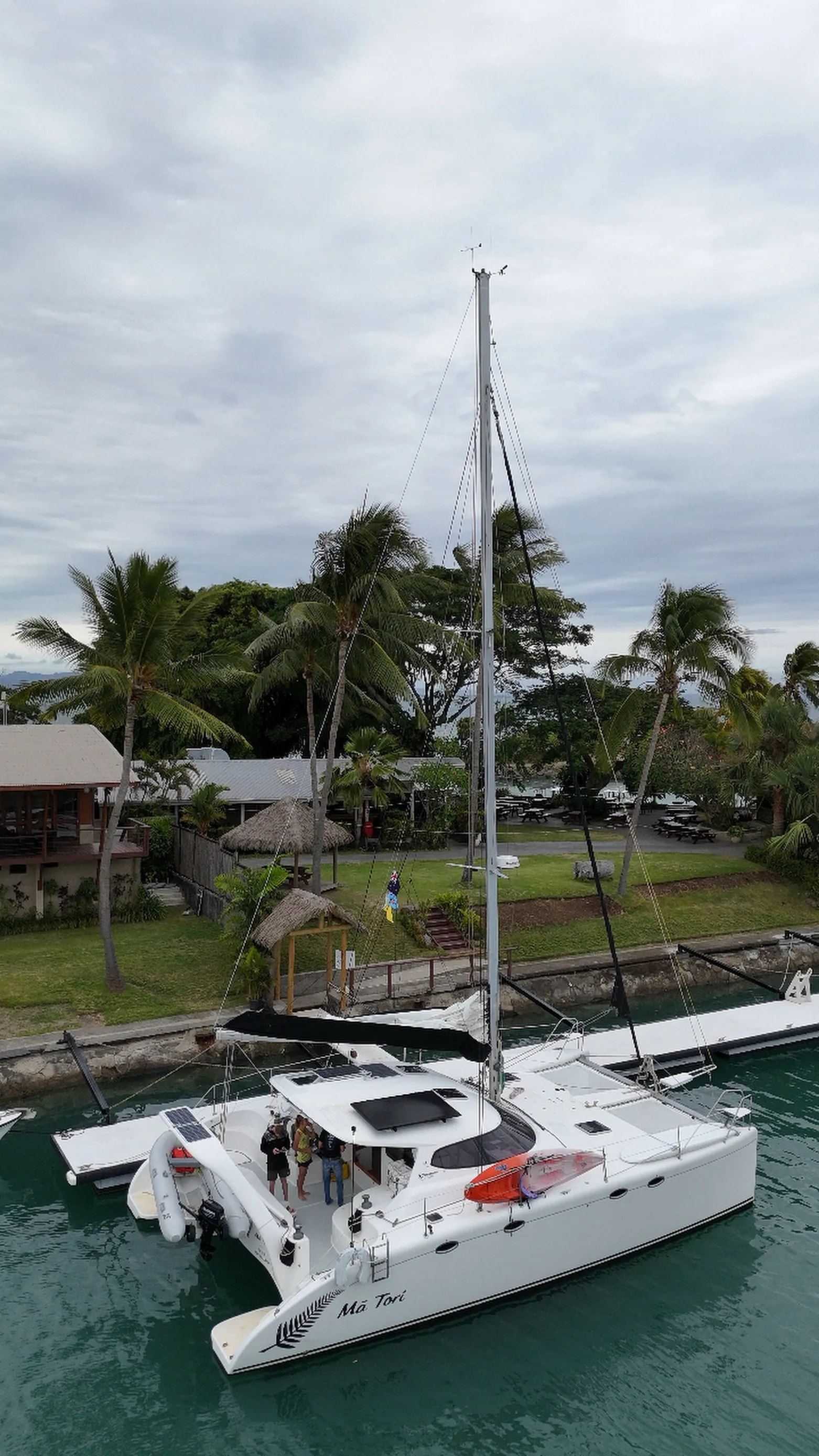
Keep reading: start with the background in what Starlink's 2026 changes actually mean for cruisers. Planning the boat as well as the bandwidth? See buying a catamaran in New Zealand and our best cruising catamarans under $500k — and if you'd like the shortcut, Mā Tori is for sale now. Offline logging and failover matter more than ever under the new rules — see connecting a PredictWind tracker to Starlink.