
Two solar-electric catamarans had their world premieres at the Cannes Yachting Festival, 8 to 13 September 2026: the Whisper 52 from Whisper Yachts in France and the Pioneer PY60 from a two year old yard in Stralsund, Germany. Both are big power cats, and both carry diesel generators for when the sun is not enough. The short version for a cruiser: solar-electric works now for marina hopping and day runs in sunshine, and on the builders' own numbers it does not yet do a 1,100 mile passage south without burning fuel. We have not been aboard either boat.
The Whisper 52: a 50 footer that grew at the back
Whisper Yachts is Guy Marchal's company, Berret-Racoupeau draw the boats, and hull one, Santa Elena, was built in Fano on Italy's Adriatic coast and did her first sea trials there over the European summer, according to the Katamarans Cannes 2026 feed. Multicoques Mag has the numbers: she was drawn as a 50 and lengthened at the aft platform for the first owner, hull length 15.55 m, beam 7.50 m, draft 0.97 m, 22 tonnes light, two 100 kW electric motors, 240 kWh of batteries and two 35 kW generators as range extenders. Cruising speed 10 knots, top speed 15, price 1,980,000 euros before VAT. From next year the production boat is badged the Whisper 54.
The builder's own page for that 54 lists 40 square metres of solar panels, 240 kWh in three 80 kWh packs, two 100 kW motors with a 120 kW boost, two HVO generators and 1,000 litres of HVO, a 12 knot top speed and "unlimited range at 5 to 6 knots". It does not give the solar wattage, the consumption at any speed or the conditions behind the unlimited claim, and its 12 knot maximum does not match the magazine's 15. The same page offers a Solar Hybrid version with two 80 kW motors and a Solar Eco-Power version with two 380 hp HVO diesels, so the yard expects some buyers to do the sums and keep the engines.
The Pioneer PY60: drawn around the sun from the first sketch
Pioneer Yachts was founded two years ago by Mike Frank, an engineer whose group has been building photovoltaic infrastructure in Germany for about twenty years, per the BoatNews launch report. Cossutti & Ganz did the naval architecture, Micheletti + Partners the interior. Hull one, Pioneer One, went in the water at Stralsund in July 2026, ran sea trials over the summer and showed at Cannes in September and Genoa in October. Frank says he will run her himself as the reference boat.
Pioneer Yachts' PY60 page, read on 30 October 2026, gives 18.30 m length, 8.88 m beam, 0.80 m draft, 30 tonnes lightship, a 16.7 kWp solar array, an LFP battery bank of 246 kWh minimum, two 50 kW propulsion motors, two 11 kW auxiliary power units, two 736 litre fuel tanks, a 48 volt system, CE Category A and about 250 square metres of interior over three levels. Speeds: 5 knots eco, 6 recommended, 7 for passages, 11 maximum. Range at 5 knots: 150 nautical miles electric, 5,000 nautical miles hybrid, with the note that it varies with sunshine, speed, wind and current. No price has been announced. The German magazine BOOTE, in its PY60 report of 3 October, that the yard measured 6.75 kW of demand at 5 knots on sea trials.
What those numbers say if you do the arithmetic
Take the PY60, the one with a measured figure. 6.75 kW for 24 hours is 162 kWh a day to hold 5 knots round the clock. A full 246 kWh bank with no sun at all carries that for about 36 hours, call it 180 miles in flat water, which is why the builder quotes 150. To do it on sunshine alone the panels would need to average 6.75 kW across every hour of the day and night. A 16.7 kWp rating is what the array makes with clean panels and the sun square on them. It is a peak, not an average, and at night it is zero. So the 5,000 mile figure is a diesel figure with solar help, and the builder is straight about that by calling it hybrid. Two 11 kW units against a 6.75 kW demand means the APUs can hold 5 knots on their own on paper, with the rest for the house, which is a sensible way to size them.
The Whisper gives less to work with. No consumption figure is published for 10 knots on two 100 kW motors. Multicoques ran a worked example, not a measurement: Fano to Cannes in twelve days at about 7 knots average on roughly 400 litres of fuel. If that holds it is a very frugal power cat, and it is still fuel.
Neither boat has a mast. On a sailing cat the rig does the passage and the electric motor only has to do the harbour work, the calms and the charging, which is a far easier sum, and it is the sum the production yards are actually working on. Fountaine Pajot's FP48 and FP55 with the ODSea+ hybrid carry up to 6,300 W of solar, Knysna's 550 Solar Explorer gives the coachroof to panels, and the aluminium Vaan R4 at Annapolis this month has no diesel at all.
Where electric already wins
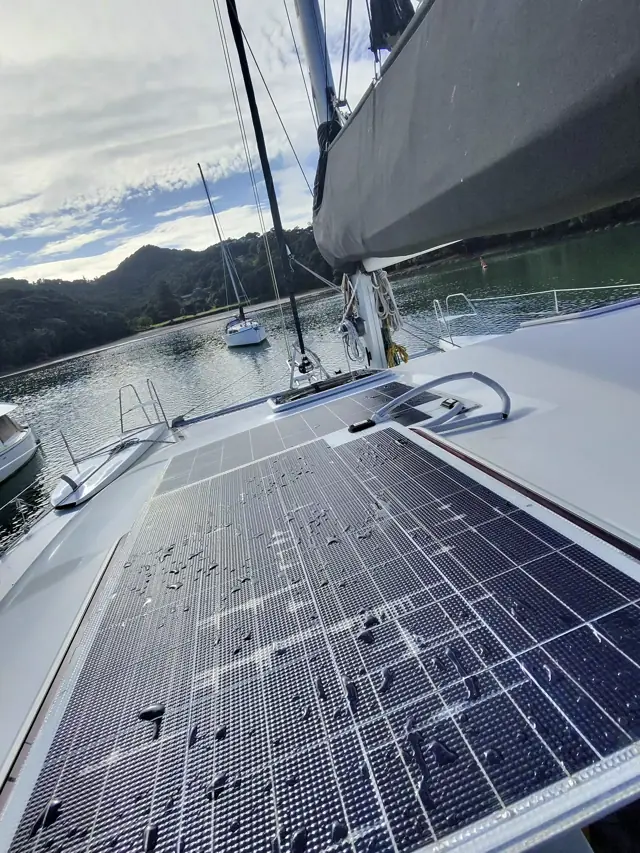
Day runs and short hops in sunshine with shore power at night: the Mediterranean, the Whitsundays, the Hauraki Gulf in summer. Electric motors have no oil to change and no impeller to replace, the boat is silent at 5 knots, and a catamaran has the deck area to carry real solar where a monohull does not. Used like that, the numbers close today.
It also wins at anchor on any cat. Mā Tori's 700 W of solar and 540 Ah lithium bank, listed on the Fusion 40 for sale page, are there for the house load: fridge, instruments, autopilot, Starlink. Solar doing the house and solar doing the propulsion are different jobs, and the gap between them is the whole story.
Where it does not yet: the passage south
The Fiji to New Zealand passage is about 1,100 miles, seven to ten days, and the part that decides whether it was a hard trip is a squash zone, where a trough meets the trades and you are upwind, wet, in a sea, under cloud, for days. Under overcast the array makes a fraction of its rating, the motors work harder than on a flat-water trial because a three deck, 30 tonne boat has windage and a sea to climb, and there is no shore power at the end of the night. That is the moment the APUs run, and from then on it is a diesel boat carrying a lot of batteries. Fine, but not the brochure.
Calms are the other half. The cyclone season plan is built around leaving late enough to miss the systems and early enough to miss the next one, and that window often means motoring through a high. A 40 foot sailing cat with two 29 hp diesels motors through it for as long as the tanks and the jerry cans last. A pure electric boat in a windless high has the sun and the bank, and the bank runs out somewhere around hour 36.
Then there is support. A small Yanmar is an engine any diesel mechanic between Opua and Denarau has seen before. Nobody has a service history on a 48 volt, 50 kW drivetrain in the islands yet, including the builder. The owner-built versus production guide asks the same question of anything unusual: who fixes it, where, and what the part costs to get there.
What we would check before buying one
- Measured consumption at cruising speed in a seaway, not flat water, and the log that shows it.
- A week of real solar yield in mixed weather, in kWh a day, from the boat itself.
- What switches off when the bank gets to 20 percent, and whether the APUs alone can hold steerage and run the house at the same time.
- The battery warranty, who honours it in Fiji or New Zealand, and the cost of a replacement pack.
- Loaded displacement. 30 tonnes light becomes something else with 1,472 litres of fuel, 600 of water and a family aboard.
- Insurance for a first-of-type drivetrain offshore. Ask before you fall for the boat.
- CE Category A is a design category, not a record of an ocean passage. Ask whether a hull has done one.
The Whisper is 1.98 million euros before tax. The PY60 has no price yet and is unlikely to be less. A refitted 40 foot sailing cat with solar, lithium and a proven passage record is a different kind of money, and it will still be sailing when the sun goes in. The Catamaran Buyer's Pack has the survey and systems checklists we would take to either boat.
What we don't know
- The Whisper 52's solar wattage, measured consumption and what hull one actually did on trials. The builder has not published them.
- The PY60's price, hull material and real solar yield, and whether the 150 mile figure starts from a full bank with no sun.
- Whether either boat has crossed an ocean. As of 30 October 2026 neither builder has published one.
We have not been aboard or seen either boat. Everything here is from the two builders, the Cannes organiser and the magazine reports linked above, read on 30 October 2026. Cannes 2027 is already on our sailing events calendar.
Questions people ask about solar-electric catamarans
Can a solar-electric catamaran cross an ocean?
Not on sunshine alone, on the numbers the builders publish. The Pioneer PY60 quotes 150 nautical miles at 5 knots on battery and 5,000 with its auxiliary power units running. Whisper quotes unlimited range at 5 to 6 knots with two HVO generators aboard. Both long range figures depend on burning fuel, and neither builder had published an ocean crossing by 30 October 2026.
How much does the Whisper 52 cost?
1,980,000 euros excluding VAT, per Multicoques Mag in September 2026. The Pioneer PY60 had no announced price at the end of October 2026.
How much solar and battery does the Pioneer PY60 carry?
A 16.7 kWp solar array, an LFP battery bank of at least 246 kWh, two 50 kW propulsion motors and two 11 kW auxiliary power units on a 48 volt system, per the builder's page. The yard measured 6.75 kW of demand at 5 knots on sea trials.
Should a sailing catamaran have electric motors?
It depends on how the boat is used. For day sails and marina work in sunshine the hybrid systems Fountaine Pajot and others are fitting make sense, because the sails do the passage and the motor does the harbour. For Pacific passages we would still want diesel aboard, because the squash zones come with cloud and the calms come with a flat battery.
Keep reading: the low power watermakers post is the other side of the same energy budget, and the Fusion 40 review covers why a light sailing cat spends fewer days motoring in the first place.